
Monthly summary
Summary of Mass Atrocities Casualties for September 2025
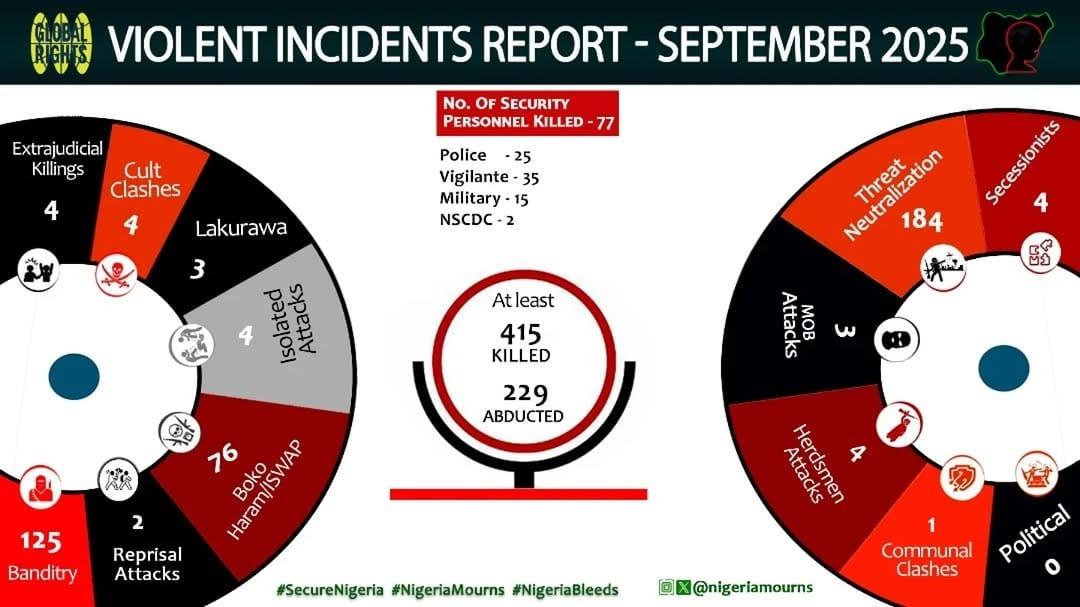
In September 2025, at least 414 people were killed and 229 abducted in incidents of armed violence across Nigeria. While recorded casualties appeared lower with a 23 percent reduction in killings and a 43 percent drop in kidnappings compared to August 2025, the persistence of targeted attacks shows that armed groups remain active and are adapting their tactics amid weak and reactive state protection.
The violence that persisted during the month remained deliberate, targeted, and directed at farmers in their fields, students in dormitories, and worshippers at prayer. These incidents are not isolated crimes but evidence of the sustained capacity of organized non-state actors to operate with impunity across both rural and semi-urban areas.
Attacks on Civilians
Civilians continued to bear the heaviest toll of violence in September, with most attacks recorded in Borno, Kaduna, Katsina, Zamfara, and Edo States. Despite official assurances of improved security, the month’s incidents revealed a recurring pattern of state incapacity and neglect.
In Borno State, tragedy struck Darul Jamal in Bama Local Government Area on September 10, when Boko Haram fighters attacked the community, killing at least sixty people, including five soldiers and thirteen civilian laborers working on reconstruction projects. Over twenty homes and ten vehicles were destroyed. The assault devastated a community that had only recently been resettled, exposing the fragility of state-led rehabilitation efforts in the absence of sustained protection.
In Kaduna State, terror-bandits invaded Wake village in Kachia Local Government Area in the early hours of September 7, killing at least eight residents, wounding more than twenty, and abducting several others. Survivors were left without access to formal relief, relying instead on volunteer networks for support. This episode underscores the government’s continued abdication of its responsibility to protect and rehabilitate victims of violence.
In Katsina State, between September 5 and 6, violence erupted in Magaji Wando, Dandume Local Government Area, resulting in the deaths of at least seven people and the abduction of three others. Members of the state-backed Community Watch Corps were ambushed during an intervention, losing two members and a patrol vehicle. The attack highlighted the vulnerability of local defense forces operating without institutional support or adequate resources.
In Zamfara State, on September 26, terror-bandits attacked a mosque in Yandoto, Tsafe Local Government Area, during early morning prayers, killing at least five worshippers and abducting several others. Such attacks on sacred spaces have deepened communal fear and eroded public confidence in the state’s ability to uphold the right to life and freedom of religion.
Similarly, in Edo State, on September 6, suspected kidnappers assaulted the BUA Cement Company site in Okpella, Etsako East Local Government Area, killing eight officers of the Nigeria Security and Civil Defence Corps and one civilian, while abducting a Chinese expatriate. The attack, which occurred within a supposedly secure industrial area, illustrates the expanding reach and sophistication of organized armed criminal groups.
Security Operations
The Nigerian military intensified counter-insurgency and counter-banditry operations across the North-East and North-West during the month, particularly under Operations Hadin Kai and FANSAN YANMA. While the armed forces reported several successful operations, the strategic impact of these offensives remains limited, as violence and reprisals continue across resettled and rural communities.
In Borno State, troops neutralized at least thirty insurgents following an assault on Darajamal, supported by precision airstrikes on Bula Madibale in the Sambisa Forest that destroyed a command hub. Yet, these tactical gains have done little to prevent recurrent attacks on civilians.
In Sokoto State, on September 4, residents of Shagari and Bimasa Local Government Areas resisted bandit attacks, reportedly killing at least fifteen assailants and rescuing kidnapped relatives. While their courage reflects community resilience, it also highlights the deep governance vacuum that compels citizens to assume roles constitutionally reserved for the state.
In Zamfara State, troops of Operation FANSAN YANMA repelled an ambush in Bungudu Local Government Area, killing at least six terror-bandits but losing three soldiers in the process.
In total, at least 77 security personnel including fifteen soldiers, twenty-five police officers, two civil defense officers, and thirty-five vigilantes were killed in the line of duty during September. These casualties underscore the high human cost of Nigeria’s security challenges and the urgent need for reforms that prioritize accountability, intelligence coordination, and civilian protection.
Abductions
Although incidents of abduction declined compared to August, they remained widespread and deeply destabilizing. At least 229 cases were recorded during the month, a 42.8 percent reduction from August’s 400 cases. Beneath this apparent improvement lies an entrenched economy of kidnapping-for-ransom that continues to undermine community stability, destroy livelihoods, and perpetuate trauma.
In Zamfara State, thirty-nine women and girls were abducted from Maniya Forest in Shinkafi Local Government Area while gathering firewood. Eleven escaped the following day, reporting sexual violence before their release. A grim reminder of the intersection between insecurity and gender-based violence. In Bukkuyum Local Government Area, twelve residents of Godai community were abducted on September 15, even as peace talks between state authorities and bandit factions were ongoing, revealing the futility of negotiations that lack justice or disarmament mechanisms.
In Cross River State, sea pirates hijacked a passenger boat traveling between Calabar and Oron on September 25, abducting at least seventeen travelers. Similarly, in Niger State, bandits ambushed vehicles along the Zugurma–Ibbi Road in Borgu Local Government Area on September 29, abducting around thirty people, including a state electoral commissioner and a former education board chairman.
Looking Ahead
The decline in recorded violence during September shouldn’t be mistaken for progress. It represents only a temporary lull within an enduring cycle of impunity. The persistence of mass atrocities across Nigeria reflects the failure of the state to meet its constitutional and international obligations to protect life, uphold human dignity, and ensure justice for victims of violence.
Breaking this cycle requires a deliberate shift toward justice-driven, rights-based, and non-kinetic strategies. Nigeria must strengthen its justice system to ensure accountability for perpetrators, reform the police to enhance investigative and forensic capacity, and expand access to education, livelihood opportunities, and infrastructure in violence-affected communities.
Rebuilding trust between citizens and the state depends on transparency, accountability, and respect for human rights as the foundation of national security. Sustainable peace will depend not on the number of insurgents neutralized, but on the number of lives protected and communities stabilized. The Nigerian government must urgently prioritize civilian protection, access to justice, and institutional accountability as non-negotiable obligations in rebuilding the nation’s social contract and restoring public confidence in the rule of law.