
Monthly summary
Summary of Mass Atrocities Casualties for October 2025
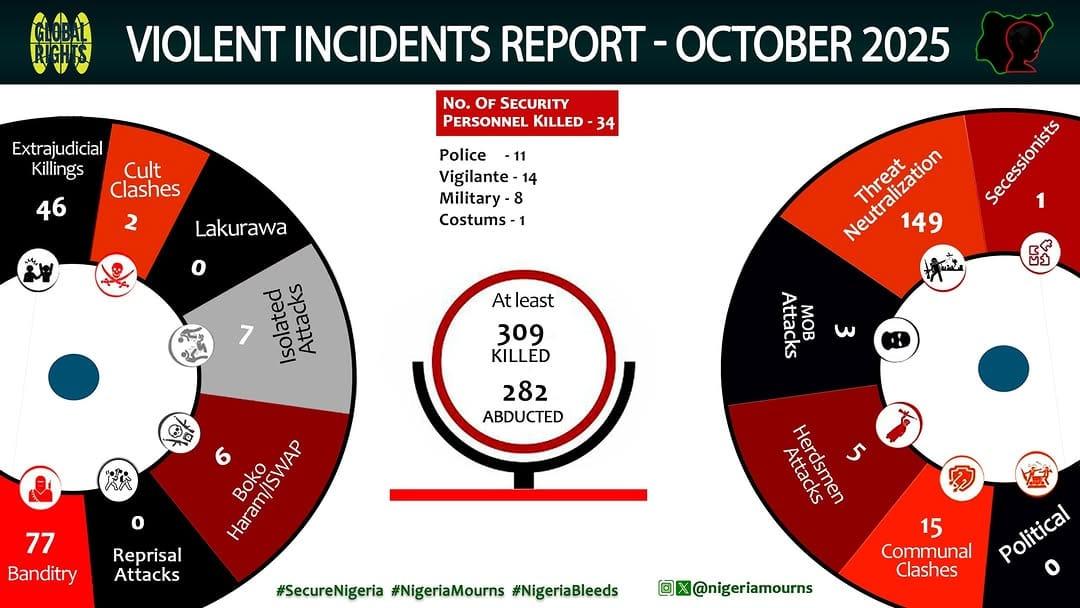
October 2025 recorded at least 309 fatalities and 282 abductions across Nigeria. These figures reflect a decline from September’s figure of 25.5 percent fewer deaths and a 20 percent increase in kidnappings. The month’s findings reveal how armed groups continue to exploit weak governance, delayed state responses, and deepening community vulnerability.
The month also saw significant shifts within Nigeria’s military leadership as President Bola Tinubu appointed new service chiefs in late October, a strategic attempt to bolster command cohesion and address internal distrust following reports of a foiled plot and the arrest of alleged coup plotters. These changes reflect the broader strain within Nigeria’s security architecture and the government’s attempt to strengthen institutional responsiveness even as violence continues.
Emerging international dynamics also shaped the month’s security discourse. After a controversial public statement by former U.S. President Donald Trump in late October calling for stronger action in response to violence in Nigeria, reports indicated that U.S. military planners drafted contingency options ranging from expanded intelligence support to limited precision capabilities. While no direct intervention is being pursued, the episode reflects how Nigeria’s prolonged insecurity is drawing renewed external attention. A development that may influence diplomatic pressure, security partnerships, and the country’s strategic environment in the months ahead.
Attacks on Civilians
October’s attacks on civilians were concentrated in Kebbi, Plateau, Kaduna, Niger, Benue, and Nasarawa States, reinforcing once again that no region is insulated from mass violence. Each incident reflected a mix of reprisal killings, opportunistic raids, and targeted assaults on communities with limited access to security.
In Kebbi State, brutal reprisal attacks between October 24 and 26 resulted in the deaths of at least 43 people across Fulani settlements in Argungu, Arewa, and Bunza Local Government Areas (LGAs). Armed vigilante groups reportedly invaded multiple hamlets, killing residents, burning homes, and triggering displacement. The cycle of retaliatory violence in the area highlights both the absence of conflict-resolution mechanisms and the dangerous rise of ethnicized armed groups.
In Plateau State, terror-bandits attacked Rachas and Rawuru communities (Barkin Ladi LGA) on October 14, killing at least 13 people and destroying farmlands. The attackers struck at night, leaving survivors fleeing through fields and rocky terrain. The assaults aggravated an already volatile agricultural season, further undermining livelihoods in a state where farming communities remain trapped between land disputes and armed raids.
In Kaduna State, the fragile peace deal in Birnin Gwari LGA collapsed when terror-bandits invaded Layin Danauta on October 16, killing at least nine people and injuring several others. A traditional ruler described the attackers as heavily armed with high-calibre rifles. The breach of the peace accord illustrated the limits of localized agreements not backed by adequate security guarantees or enforcement.
In Niger State, a communal clash between Nupe and Fulani communities erupted in Ezhigi (Edati LGA) on October 21, leading to at least four deaths and multiple displacements. The incident reflects escalating tensions over land use and grazing routes, worsened by the absence of effective mediation structures.
Additional attacks in Benue (at least 8), Nasarawa (9), Zamfara (7), Kogi (5), and other states highlight the expanding geography of civilian vulnerability. Across regions, communities continue to face the dual burden of ongoing violence and declining faith in state protection.
Security Operations
Security forces intensified counter-banditry and counter-insurgency operations under Operations Hadin Kai and FANSAN YANMA, conducting land and air offensives across the North-East and North-West. While several operations reported high insurgent casualties, the persistence of reprisal attacks and continued targeting of rural communities reveal the limited strategic impact of these engagements.
In Borno State, troops under Operation Hadin Kai neutralized at least 50 ISWAP insurgents, including five commanders, in coordinated operations across Kararko, Dikwa, Gajibo, and Mafa. Multiple attempted attacks were repelled, and several insurgent vehicles and weapons were recovered. On October 10, troops also repelled an ISWAP assault in Ngamdu (Kaga LGA), neutralizing at least 15 fighters.
In Kwara State, security forces neutralized 15 terror-bandits during a joint operation along the Kogi–Kwara border on September 29, following an attack in Oke-Ode the previous day. The operation disrupted a bandit cell that had been targeting communities and transport routes along state boundaries.
In Katsina State, at least 12 bandits were neutralized during an offensive in Mabai (Kankara LGA). The assault took place shortly after a peace accord meeting with local stakeholders in Kakumi village, underscoring once more the volatility of agreements made without parallel disarmament and monitoring.
Despite operational gains, the security sector suffered significant losses. At least 77 personnel including 8 soldiers, 11 police officers, and 14 vigilantes were killed in action. These casualties reflect the immense human cost of ongoing deployments and highlight the urgent need for better equipment, improved intelligence coordination, and consistent post-operation support for security personnel.
Abductions
At least 282 abductions were recorded in the month of October. A 20 percent rise from the previous month. Kidnapping remained one of the most pervasive and profitable tactics employed by armed groups, affecting rural communities, religious centers, roadways, and border settlements.
In Zamfara State, large-scale kidnappings dominated the month. On October 18, terror-bandits stormed Buzugu and Rayau villages (Bukkuyum LGA), abducting at least 73 residents during a midnight raid. Earlier on October 7, another group invaded Zamfarawa village (Zugu District), abducting at least 30 people in broad daylight. At Yandoto town (Tsafe LGA), at least 20 worshippers were abducted in the mosque during morning prayers.
In Kogi State, at least 40 travellers were kidnapped along the Kogi–Benue corridor, reflecting the growing insecurity on inter-state transport routes. Separately, in Owan West LGA of Edo State, at least 10 travellers were abducted in Sabo-Gidda Ora.
In Niger State, at least 10 passengers were abducted along the Kontagora–Yauri road, a stretch increasingly targeted by mobile bandit units.
Looking Ahead
October’s patterns make clear that Nigeria’s security trajectory cannot be reversed through kinetic force alone. Sustainable progress requires strengthening the criminal justice system with functional courts, prosecutorial capacity, and police units equipped with modern forensic tools to ensure consequences for violence. Equally vital is human development: improving access to education, food systems, infrastructure, and energy to reduce community vulnerabilities that armed actors exploit.
At the same time, the recent reshuffle in military leadership highlights how internal dynamics within the armed forces have become a factor in the country’s security outlook. The appointments aim to reinforce professionalism and vigilance, but they also come amid heightened political sensitivity of suspected coup plot and broader regional tensions. Strengthening leadership cohesion and accountability within the security institutions will be essential to sustain operational effectiveness and public trust.
Beyond internal reforms, international strategic interest in Nigeria’s security environment may grow. Draft contingency plans prepared by external military actors focused on intelligence sharing, logistics, and potential precision operations reflect how prolonged violence is being viewed as a regional threat with global implications. Though full-scale external intervention remains unlikely and controversial, increased international engagement could prompt new forms of partnership or pressure that influence Nigeria’s domestic response strategies.
Ultimately, sustainable peace will depend not on the number of insurgents neutralized, but on the number of lives stabilized. By pairing security action with justice reform, social investment, and inclusive governance, and by ensuring that institutional change and regional cooperation support rather than undermine national sovereignty, Nigeria can begin to turn temporary calm into lasting stability.