
Monthly summary
Summary of Mass Atrocities Casualties for November 2025
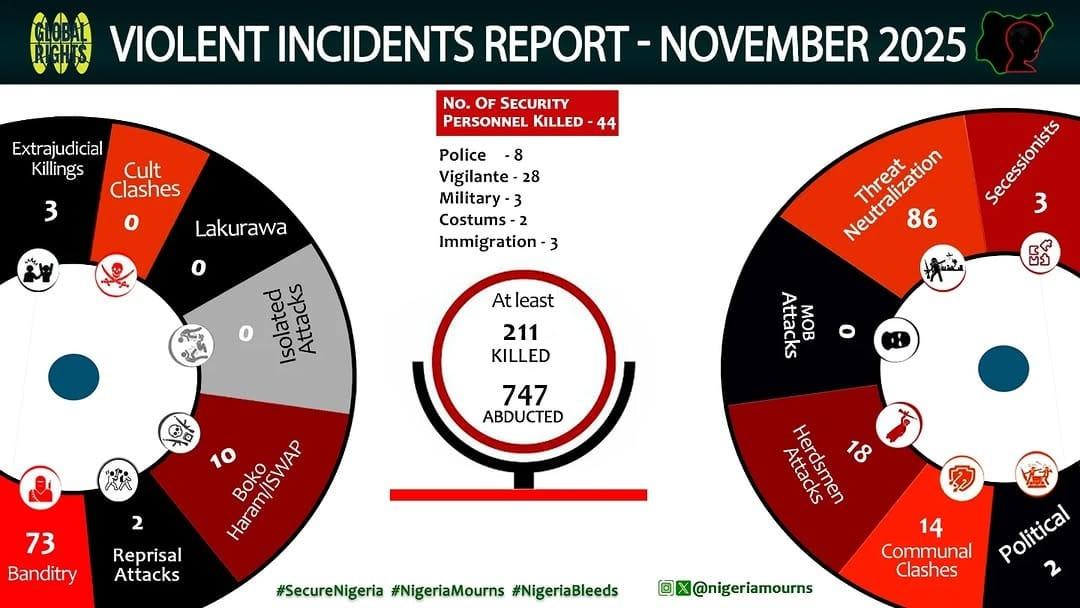
November 2025 marked a troubling inflection point in Nigeria’s insecurity landscape. At least 211 people were killed nationwide, while at least 747 abductions were recorded. Although fatalities declined by approximately 25.5 percent compared to October, the 165 percent surge in kidnappings represented one of the sharpest monthly increases recorded this year. This could reflect a strategic adaptation by armed groups, with mass abduction increasingly favoured as a low-risk, high-impact tactic that generates revenue, leverage, and sustained psychological pressure while avoiding direct confrontation with security forces.
The scale, coordination, and targeting of November’s kidnappings particularly against schools, religious institutions, and rural communities deepened national anxiety and public outrage. Children, teachers, worshippers, and farmers were disproportionately affected, reinforcing the reality that everyday civilian spaces have become normalized theatres of violence. While some abductees were eventually rescued through security pressure and negotiation, the sheer volume of incidents exposed the fragility of deterrence and the limited preventive reach of state protection.
November’s insecurity unfolded amid heightened political transition and international scrutiny of Nigeria’s violence dynamics. Changes within the country’s security leadership, alongside intensified global rhetoric around religiously motivated violence, placed additional strain on already overstretched command, intelligence, and response structures. While no direct causal link can be established, armed groups operate in a perception-driven environment that is sensitive to shifts in authority, attention, and opportunity. Recent leadership changes, strained intelligence systems, international attention, and worsening socio-economic pressures likely created conditions that armed groups exploited to shape when they struck, who they targeted, and why kidnappings, particularly of Christian institutions and communities, increased.
November’s data suggests that Nigeria’s insecurity is not receding, but reorganising around tactics that maximise fear, revenue, and leverage while minimising armed confrontation.
Attacks on Civilians
Civilian populations continued to bear the brunt of violence in November, with lethal incidents concentrated in Benue, Plateau, Kaduna, and Kwara States, alongside smaller but significant attacks elsewhere. These incidents reflected a mix of reprisal killings, communal violence, and opportunistic raids in areas where security presence remains limited and response times delayed.
In Benue State, armed attackers raided Anwuel community in Ohimini Local Government Area (LGA) over two consecutive days, killing at least seven residents. Survivors described the night-time assaults that forced families to flee into surrounding bushland, further entrenching displacement in already vulnerable rural areas and disrupting farming activities critical to local food security.
In Plateau State, coordinated attacks struck Kwi community (Riyom LGA) and Pushit community (Mangu LGA) between October 31 and November 1, killing at least ten people. Homes and farmlands were destroyed, reinforcing patterns of cyclical violence that continue to undermine agricultural livelihoods and stall post-conflict recovery efforts across central Plateau communities.
In Kaduna State, gunmen attacked Damakasuwa community in Chawai Chiefdom, Kauru LGA, killing at least seven people and injuring another. Residents described sustained gunfire lasting several minutes without immediate security response, highlighting persistent protection gaps in rural settlements and reinforcing perceptions of abandonment.
Additional attacks in Kwara (at least six fatalities), Kogi (four), Zamfara (four), Kano (four), and other states reaffirmed that the geography of civilian vulnerability remains national rather than regional. Across affected areas, communities faced not only the trauma of violence but a deepening erosion of confidence in the state’s ability to prevent attacks before they occur, accelerating displacement and reliance on self-help security arrangements.
Security Operations
Security forces sustained counter-insurgency and counter-banditry operations under Operations Hadin Kai, FANSAN YANMA, MESA, and Garkuwan Arewa, recording several tactical successes while continuing to face high operational risks. November once again underscored the persistent gap between battlefield gains and durable civilian protection.
In Borno State, violent clashes between Boko Haram factions Jamā’at Ahl as-Sunna lid-Da‘wa wa’l-Jihād (JAS) and Islamic State West Africa Province (ISWAP) resulted in the reported deaths of at least 50 fighters in Toumbun Gini, Abadam LGA. More consequentially, ISWAP fighters ambushed troops during a routine patrol in Damboa LGA, killing Brigadier General M. Uba, Commander of the 25th Brigade. The targeted killing of a senior commander highlighted both insurgent intelligence penetration and the growing threat posed by precision attacks against leadership figures.
In Kano State, troops of Joint Task Force Operation MESA, acting on actionable intelligence, neutralised at least 19 bandits in Shanono LGA, though two security personnel were killed during the operation.
In Zamfara State, troops under Project Garkuwan Arewa neutralised at least six bandits and recovered weapons during operations in Tsafe LGA.
Despite these engagements, at least 39 security personnel including three soldiers, eight police officers, and 28 vigilantes were killed during the month. The sustained loss of both formal security forces and community defenders reflects the attritional nature of the conflict and the urgent need for improved intelligence coordination, force protection, and post-operation recovery support. Without these, tactical successes risk being offset by declining morale and reduced operational endurance.
Abductions
Kidnapping dominated Nigeria’s insecurity profile in November. At least 747 abductions were documented nationwide, making the month one of the most severe periods for mass hostage-taking in 2025. Abductions increasingly function as both an economic engine and a tool of coercion, reshaping civilian behaviour and undermining social institutions.
The most significant incident occurred in Niger State, where armed groups abducted at least 315 students and teachers from St. Mary Catholic Institution in Papiri community, Agwara LGA, on November 20. The attack sent shockwaves across the country, reviving fears of a return to large-scale school abductions and threatening fragile gains in rural education access. Beyond the immediate trauma, the incident risked long-term withdrawal from schooling as families reassessed the safety of educational institutions. As of reporting, at least 11 abductees had been rescued.
In Zamfara State, terror-bandits attacked Fegin Baza community (Tsafe LGA), killing at least three people and abducting at least 64 others, including women and children. Among the dead was a prominent political figure, illustrating how kidnapping increasingly intersects with local power dynamics and political influence.
In Kwara State, at least 38 worshippers, including a pastor, were abducted during a church service in Eruku, Ekiti LGA. Although captives were later rescued following intensified security operations, the incident reinforced the vulnerability of religious spaces and the psychological impact of attacks on communal gathering points.
Additional abductions were recorded in Kogi (29 travellers), Kebbi (25 schoolgirls abducted and later rescued), Borno (13 female farmers), and Kano (21 residents). Collectively, these incidents demonstrated how kidnapping has evolved into a parallel economy, one that disrupts education, agriculture, commerce, and mobility while inflicting long-term trauma on survivors and weakening trust in public institutions.
Looking Ahead
Looking ahead, Nigeria’s security trajectory must be understood within the broader context in which violence is planned, perceived, and exploited. The intersection of recent security leadership changes heightened international attention, and politically charged narratives around religious violence may have subtly but materially reshaped the operational environment. Even in the absence of direct coordination or intent, such moments can strain intelligence continuity, weaken command cohesion, and embolden armed groups seeking visibility, leverage, or ideological signalling.
The surge in abductions and the disproportionate targeting of Christian institutions and communities in November suggest that armed actors may have deliberately calibrated violence to exploit perceived uncertainty, amplify fear, and internationalize their impact. Without deliberate efforts to stabilize intelligence systems, reinforce civilian protection during periods of political transition, and manage the unintended security effects of external rhetoric, similar patterns of opportunistic escalation may recur in the months ahead.
Without coordinated action that integrates security operations with governance reform and human development, Nigeria risks entrenching a cycle in which abductions replace mass killings not as a reduction in violence, but as its evolution into a more pervasive and corrosive form.