
Monthly summary
Summary of Mass Atrocities Casualties for May 2026
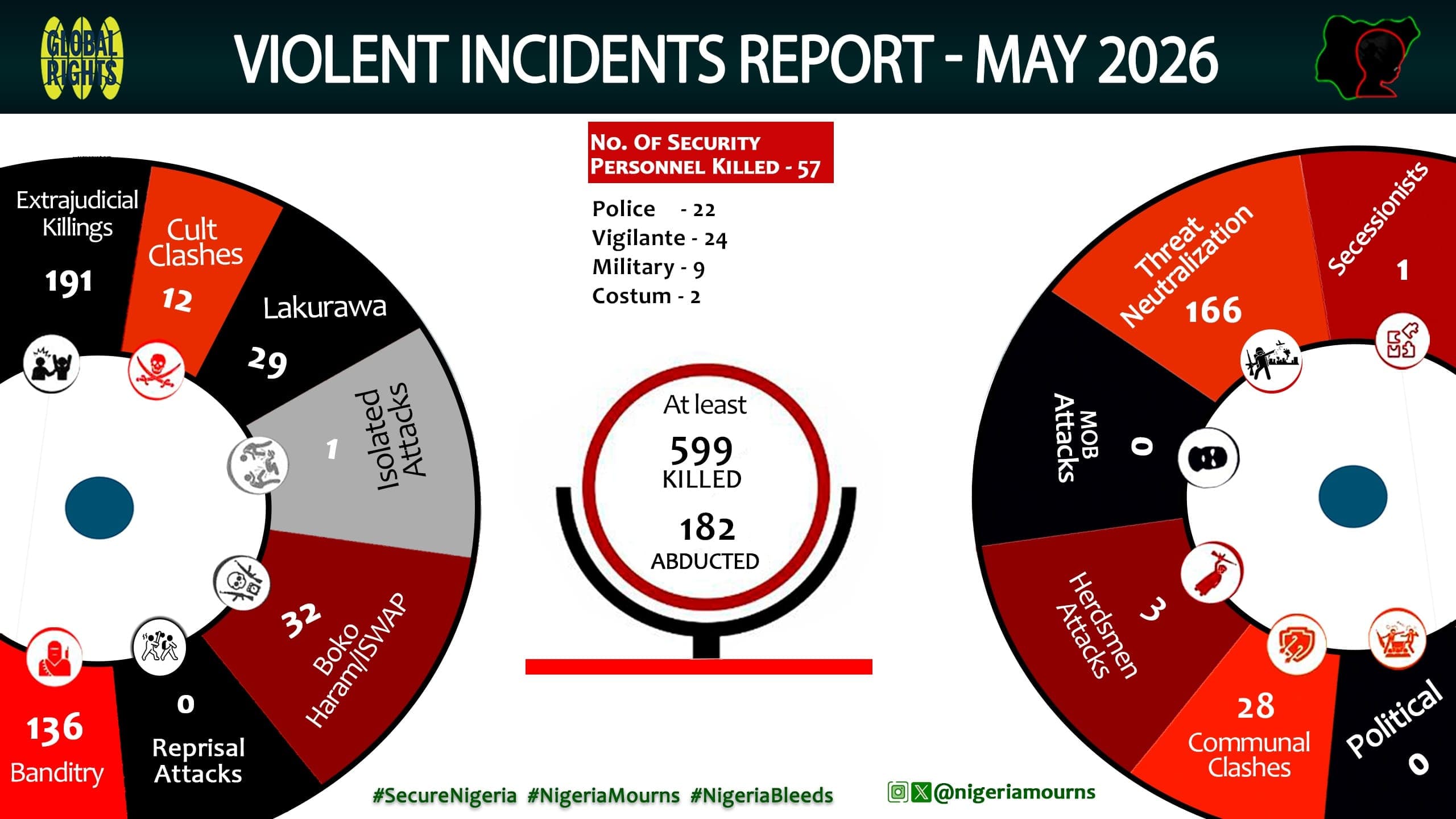
May 2026 recorded at least 361 fatalities and 181 abductions across Nigeria. Compared to April, both fatalities and kidnappings declined, suggesting a temporary reduction in the scale of violence. However, the month’s incidents indicate another shift in the character of insecurity rather than a sustained improvement. Large-scale civilian deaths were increasingly linked not only to insurgent and bandit attacks but also to the consequences of military operations, reflecting the growing complexity of Nigeria’s conflict environment.
The month was marked by deadly attacks on travellers, rural communities, and educational institutions, while reported airstrikes in Zamfara and Niger States resulted in significant civilian casualties, raising renewed concerns over civilian protection during security operations. Although fewer mass abductions were recorded than in previous months, the continued targeting of schools demonstrated that armed groups remain capable of exploiting vulnerable civilian infrastructure to generate fear and disrupt access to education.
Attacks on Civilians
Civilians continued to bear the greatest burden of violence during May, with major incidents recorded in Zamfara, Niger, and Katsina States.
In Zamfara State, terrorists ambushed travellers along a highway in Maradun Local Government Area (LGA), killing several passengers and abducting others. The attack reinforced the continued vulnerability of transport corridors, particularly in the North-West, where armed groups retain freedom of movement.
The deadliest incident of the month occurred in Zamfara State, where a military airstrike targeting armed groups reportedly struck a busy market in Maru LGA, killing more than 100 civilians. The incident renewed concerns about intelligence accuracy, target verification, and the protection of civilian populations during counter-insurgency operations.
In Niger State, another reported airstrike in Shiroro LGA killed several civilians, including three children from the same family, highlighting the recurring humanitarian consequences of military operations conducted in populated areas.
In Katsina State, suspected bandits attacked a village in Kankara LGA, killing at least 16 residents during a night raid and further illustrating the persistent threat facing rural communities despite ongoing security deployments.
Security Operations
Security forces sustained offensive operations against insurgent and bandit networks across the North-East and North-West, continuing efforts to disrupt armed groups through coordinated ground and air operations.
In Zamfara State, troops conducted separate offensives that neutralised more than 40 terrorists and recovered weapons during operations targeting bandit strongholds across the state.
In Borno State, a joint Nigerian and United States air operation reportedly killed more than 20 ISWAP fighters, reflecting continued international security cooperation aimed at degrading insurgent capabilities in the North-East.
Despite these operational gains, security forces continued to incur losses. At least nine soldiers, 22 police officers, 24 vigilantes, and two Customs officers were killed during the month, underscoring the sustained risks faced by frontline personnel and community defenders operating across multiple conflict theatres.
Abductions
At least 181 abductions were documented nationwide during May, representing a further decline from April. Nevertheless, kidnapping remained a persistent feature of Nigeria’s insecurity landscape, with educational institutions once again emerging as prominent targets.
The most significant incident occurred in Kebbi State, where armed men attacked schools in Birnin Yauri LGA, abducting at least 39 students and seven teachers during coordinated raids. The attacks revived concerns over the continued vulnerability of schools despite previous government initiatives aimed at improving their protection.
Additional kidnappings were reported across several states, including attacks on travellers and rural communities, demonstrating that while the overall number of abductions declined, armed groups continue to exploit predictable civilian activities to generate ransom, spread fear, and undermine confidence in public safety.
Looking Ahead
May’s trends suggest that Nigeria’s security landscape continues to evolve rather than stabilize. While both fatalities and kidnappings declined compared to April, the emergence of high civilian casualties associated with military air operations illustrates the increasingly complex balance between degrading armed groups and protecting civilian lives.
The continued targeting of schools, highways, and rural settlements demonstrates that armed actors remain capable of adapting their tactics despite sustained military pressure. At the same time, incidents involving civilian casualties during security operations risk undermining public confidence, complicating intelligence gathering, and weakening community cooperation with security agencies.
As Nigeria enters the middle of 2026, sustaining security gains will depend not only on continued offensive operations but also on improving intelligence precision, strengthening civilian protection measures, and restoring confidence in state institutions. Reducing the human cost of both armed attacks and military responses will remain critical to reversing the country’s evolving insecurity trajectory.