
Monthly summary
Summary of Mass Atrocities Casualties for May 2025
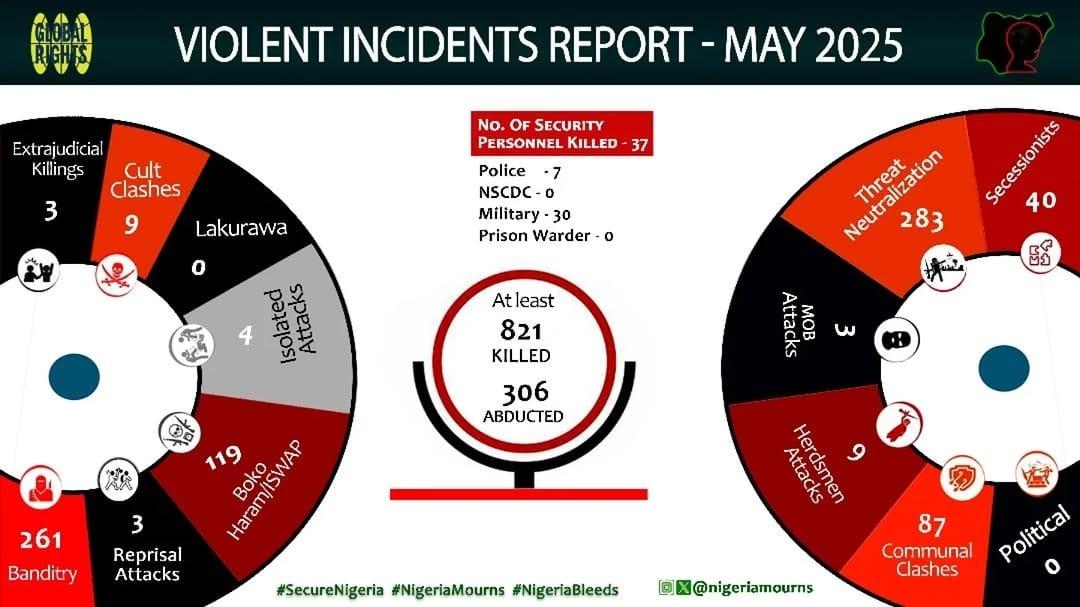
Summary of Mass Atrocities Casualties for May 2025
May 2025 marked another month of widespread bloodshed, revealing the entrenched and fragile state of Nigeria’s internal security landscape. Across the country, at least 821 people were killed and 306 abducted, reflecting a 27.5 percent increase in fatalities and an 8.6 percent rise in abductions compared to April.
The violence cut across all regions, sustained by a broadening ecosystem of insecurity fuelled by weak deterrence, fractured governance, and deepening community despair. While security forces claimed limited tactical gains, the data points to a steady normalization of civilian vulnerability. The high casualty toll and persistent mass abductions signal a crisis that extends beyond the battlefield to the erosion of public trust and the state’s fundamental capacity to protect its citizens.
Attacks on Civilians
May witnessed an expansion in both the scope and intensity of armed violence, with Benue, Taraba, and Borno States accounting for a significant share of reported deaths.
In Benue State, at least 104 people were killed in a series of brutal assaults on farming communities. On May 12, gunmen invaded Tse Antswam near Naka town (Gwer West Local Government Area), killing 43 residents in an overnight raid that forced survivors to flee into nearby forests and wells. In Gwer East, an outbreak of communal conflict between Mbakine and Ojumole villages left at least 15 dead and over 200 homes destroyed, further straining humanitarian conditions. Additional attacks in Logo, Kwande, Ukum, and Guma LGAs claimed the lives of at least 24 farmers, many ambushed while attempting to resume cultivation amid rising food insecurity.
In Taraba State, at least 107 fatalities were recorded, most of them in Karim Lamido LGA, where a dispute over farmland escalated into a cycle of reprisal attacks. On May 23, motorcycle-riding bandits stormed several settlements, killing at least 40 residents and displacing hundreds. Communities such as Munga Lalau and Munga Doso were attacked twice within weeks upon return from displacement.
Borno State endured one of the month’s most horrific incidents on May 15, when Boko Haram’s Shekau faction executed at least 70 farmers in Malam Karanti (Kukawa LGA). Over 100 people remain missing. Residents described being forced to pay “taxes” to ISWAP to farm or fish, a coercive practice that blurs the line between survival and subjugation.
Other attacks reinforced the nationwide scale of violence:
- Kebbi State: at least 18 people killed and several abducted during an assault on Zagani church service.
- Imo State: at least 30 travellers killed in an ambush along the Okigwe–Owerri highway.
- Katsina State: at least 10 residents killed in a night raid on Gobirawa village.
- Plateau State: at least 12 killed in late-night attacks on Wereng Camp and Chido communities.
- Bauchi, Adamawa, and Bayelsa States recorded at least 37 deaths combined in scattered attacks.
Behind these figures are families forced into displacement, farms left fallow, and communities that no longer expect or wait for help to arrive.
Security Operations
Security operations intensified across the North East, North West, and North Central zones in May, with at least 272 insurgents neutralised. Yet, 60 security personnel including 30 soldiers, 7 police officers, and 23 vigilantes also lost their lives, illustrating both the scale of commitment and the cost of attrition.
In Borno State, troops under Operation Hadin Kai repelled a major attack in Bita LGA, killing at least 60 insurgents with combined air and ground support. In Zamfara’s Maru LGA, targeted airstrikes destroyed militant camps and logistics hubs, neutralising at least 20 fighters.
In Katsina State, Operation Forest Sanity III dismantled a fortified insurgent base in Faskari LGA, neutralising at least 22 militants and recovering arms, motorcycles, and stolen livestock.
Meanwhile, in Taraba State, joint forces under Operation Whirl Stroke neutralised at least 20 assailants during a raid in Old Muri LGA, recovering cattle and weapons.
While these operations disrupted some militant cells, they did little to reverse the broader tide of violence. Communities often experienced renewed attacks within days of military withdrawals, highlighting the absence of sustained presence, local intelligence integration, and community protection strategies.
Abductions
At least 306 abductions were documented in May. Up from 285 in April, marking another month of widespread hostage-taking that cut across regions and demographics. The incidents underscored kidnapping’s dual function: an economic enterprise and an instrument of terror designed to enforce submission.
In Kebbi State, one of the largest abduction events of the year unfolded on May 27, when armed groups kidnapped at least 127 residents from Danmuntari and Ali villages (Danko-Wasagu LGA) in a daylight raid that also killed at least six people. A week earlier, ten women were seized during church service in Zagani village.
In Zamfara State, reprisals following military strikes led to the abduction of dozens of villagers across Maru and Kaura Namoda LGAs, with at least 26 people kidnapped in raids between May 9 and 11.
In Borno State, ISWAP abducted at least 18 farmers from Malam Karanti, adding to the community’s earlier massacre.
Elsewhere, Katsina’s Gobirawa village recorded the abduction of at least 10 residents, while in Rivers State, sea bandits hijacked a passenger boat along the Isaka River, taking at least 13 people hostage, including the vessel’s operator.
Across all incidents, survivors documented prolonged captivity, ransom payments, and assaults, reinforcing the sense that kidnapping has become institutionalized within Nigeria’s conflict economy with limited deterrence or accountability.
Looking Ahead
May’s escalation in killings and abductions emphasises the urgent need to redefine Nigeria’s approach to national security. While military operations continue to deliver tactical victories, they are insufficient against the social, economic, and institutional roots of persistent violence.
Preventing further deterioration requires a human-centric strategy anchored in justice, governance reform, and development. Strengthening investigative policing and forensic capacity can improve accountability, while equitable access to education, livelihoods, and energy infrastructure can reduce the socioeconomic incentives for armed recruitment.
Equally vital is restoring public confidence through transparency and timely protection. Until security responses prioritize the dignity and safety of citizens and not just the defeat of adversaries, the cycle of violence will continue to erode Nigeria’s stability and social fabric.