
Monthly summary
Summary of Mass Atrocities Casualties for March 2026
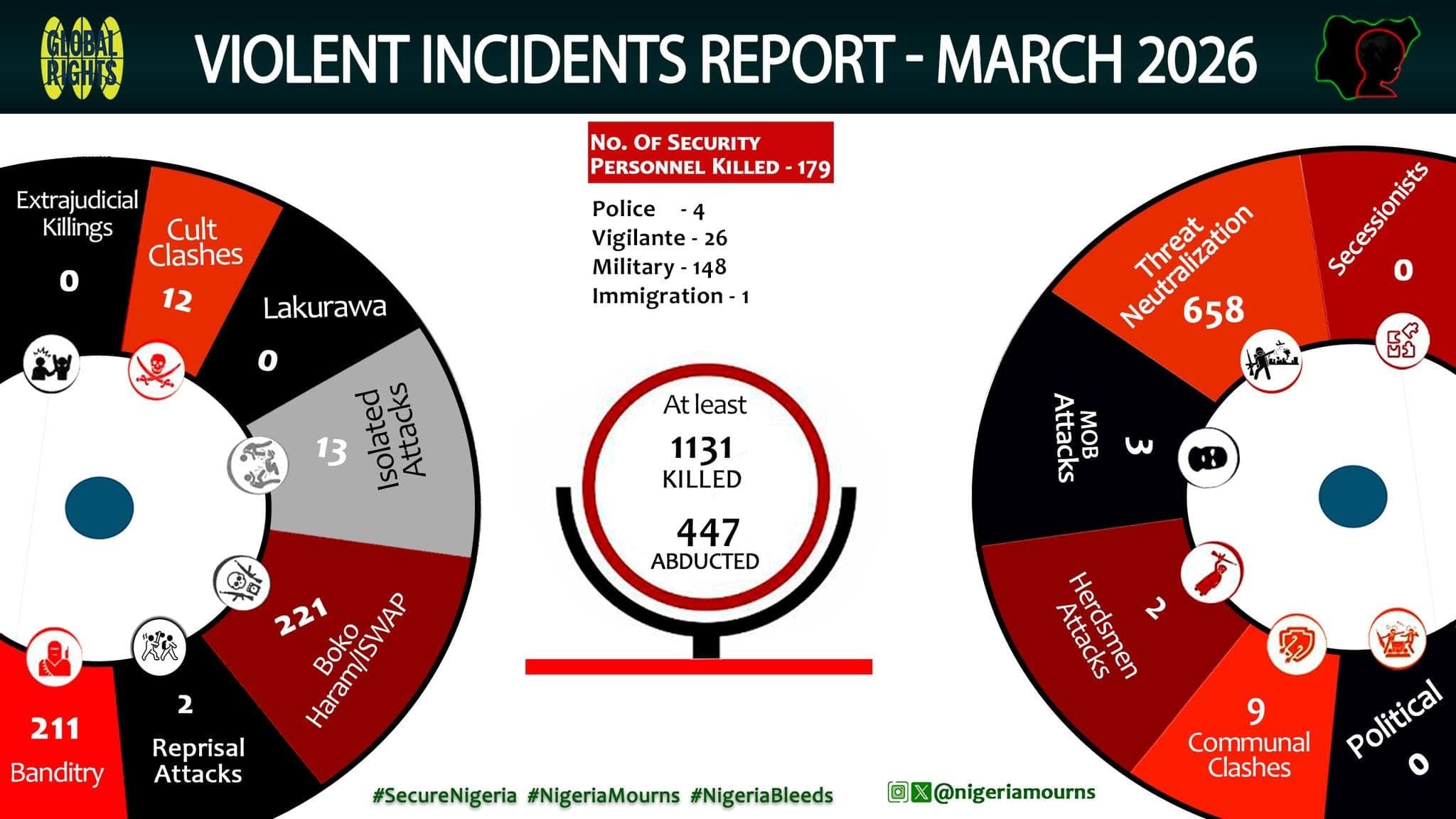
March 2026 recorded at least 266 fatalities and 446 abductions across Nigeria. While fatalities declined sharply from February’s exceptionally high levels, kidnappings more than doubled, indicating another tactical adjustment by armed groups as security operations intensified across several theatres.
Rather than concentrating on large-scale massacres, violence spread across farming communities, logging camps, weddings, and settlements already weakened by years of conflict. At the same time, insurgent groups demonstrated a renewed ability to strike military positions, highlighting that sustained operational pressure has not diminished their capacity to threaten both civilians and security forces.
Attacks on Civilians
Civilians continued to bear the greatest burden of violence during March, with major attacks recorded in Borno, Plateau, Benue, and Kaduna States.
In Borno State, insurgents overran a military base, while separate attacks on logging communities in Kukawa Local Government Area (LGA) left at least 20 civilians dead and dozens abducted. The incidents reinforced the continued vulnerability of remote communities whose livelihoods depend on forest activities.
In Plateau State, coordinated attacks in Bassa and Jos North LGA left several residents dead and prompted the imposition of a curfew, underscoring persistent communal tensions and the growing insecurity affecting urban and peri-urban communities.
In Benue State, at least 15 villagers harvesting cashew were killed in Gwer West LGA, illustrating how agricultural activities remain increasingly exposed to violence.
In Kaduna State, armed men attacked a wedding ceremony in Kajuru LGA, killing at least 13 people and abducting numerous guests. The attack demonstrated that social gatherings continue to provide attractive targets for armed groups seeking maximum psychological impact.
Security Operations
Security forces intensified counter-insurgency and counter-banditry operations across the North-East, North-West, and North-Central regions.
In Borno State, military operations around Malam Fatori reportedly resulted in the deaths of more than 75 ISWAP fighters, while additional offensives disrupted insurgent positions across the state.
Further operations in Zamfara, Kogi, and Benue States neutralized numerous bandits and terrorists while preventing attacks on vulnerable communities.
Despite these tactical successes, March recorded one of the highest security force casualty figures of the conflict. At least 148 soldiers, four police officers, and 26 vigilantes were killed during the month, underscoring the increasing intensity of engagements and the continued ability of armed groups to inflict significant losses on frontline personnel.
Abductions
At least 446 abductions were documented nationwide during March, confirming that kidnapping remains a central component of armed group strategy.
In Borno State, Boko Haram released footage reportedly showing hundreds of abducted villagers, highlighting the scale of civilian captivity and the continued use of hostage-taking to project influence and intimidation.
In Kaduna State, bandits attacked communities in Kagarko LGA, abducting numerous residents during coordinated raids.
In the Federal Capital Territory, gunmen abducted at least 16 people from Kubwa, demonstrating that organized criminal networks continue to operate close to Nigeria’s political centre and extending perceptions of insecurity beyond traditional conflict zones.
Looking Ahead
March reinforced a pattern that has emerged throughout the first quarter of 2026. Armed groups continue to adapt their tactics in response to security pressure, alternating between mass casualty attacks and large-scale kidnappings while exploiting weaknesses in rural protection and intelligence coverage.
The continued targeting of farming communities, commercial activities, transport routes, and social gatherings extends the consequences of insecurity beyond immediate casualties. These attacks undermine agricultural production, disrupt local economies, increase displacement, and further erode public confidence in state protection.
The exceptionally high losses suffered by security personnel also raise concerns about operational sustainability as forces confront increasingly capable and adaptive armed groups across multiple theatres simultaneously.
As Nigeria enters the second quarter of 2026, the conflict continues to evolve rather than diminish. While sustained military operations have disrupted several armed networks, the broader drivers of insecurity remain largely unchanged, allowing violence to persist through changing tactics and expanding geographic reach.