
Monthly summary
Summary of Mass Atrocities Casualties for March 2025
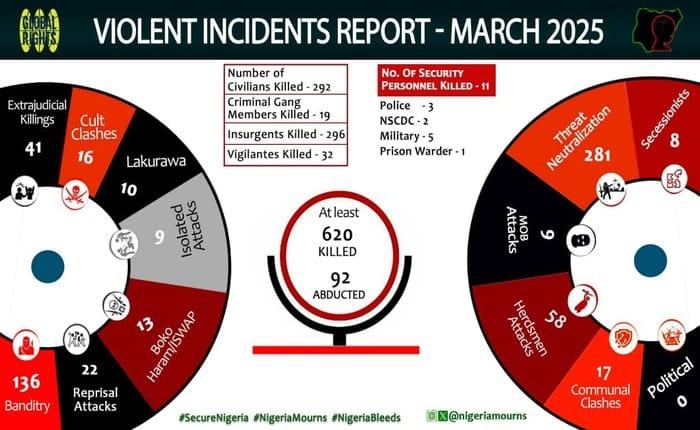
There was a sharp increase in the number of fatalities from mass atrocities across Nigeria in March 2025, with at least 620 fatalities recorded – a 41% surge from the previous month’s 367 deaths. The North-West region remained the epicenter of the violence, as terror-bandits escalated attacks on rural communities. The resurgence of attacks underscores the fleeting nature of the tactical gains of kinetic counterterrorism and the urgent need for sustainable strategies to break the cycle of retaliation and revenge.
The month’s violence did not deviate from established patterns of:
- rampant abductions targeting communities and farms.
- sophisticated attacks and abductions of travelers on major roads.
- arson targeting homes and farmlands in agrarian communities.
While February’s decline in casualties had kindled cautious optimism, March’s grim tally confirms that without addressing root drivers—impunity, inequality, and institutional distrust—Nigeria’s security crisis will continue to metastasize.
Casualty Overview
Zamfara State bore the brunt of March’s violence, with at least 50 people killed in coordinated attacks by terror-bandits who unleashed a 48-hour rampage across three Local Government Areas. The onslaught began on March 20th in Tudun-Biri village (Talata-Mafara LGA), where attackers razed a Fulani settlement at dawn, killing one and displacing dozens. “They arrived on motorcycles, burning huts and shooting anyone who resisted. We fled with only the clothes on our backs,” recounted survivor Habibu Musa. Hours later, at 6:32 p.m. in Gurusu (Bukkuyum LGA), vigilantes repelled an assault on a Civilian Joint Task Force camp after a 90-minute firefight, narrowly averting further casualties. The violence culminated on March 21 with a midnight raid on Gidan Fulani village (Kaura-Namoda LGA), where bandits rustled cattle unchallenged. “By the time we returned, our livelihood was gone,” said herder Yusuf Sani.
In Abia State, the grim discovery of at least 30 unidentified bodies in the Imo River exposed a ritual killing network operating with impunity. Traditional ruler Eze Philip Ajomiwe described the horror: “These young women are dumped like trash under the cover of darkness. The community decried the lack of security presence in their community, which forced them to self-organize with limited resources. Our vigilantes lack even torches to patrol the riverbanks at night.” No arrests had been made at the time of this report, perpetuating the atmosphere of fear in the community.
At least 20 farmers were killed in overnight raids by terror-bandits across Aba Pastor, Aba Sunday, and Ademekun Camp (Akure North LGA), Ondo State. Survivor Ezekiel, who hid in the bush for three days, recounted: “They shot at anything that moved—men, women, even livestock. The smell of burnt cassava farms still haunts us.” Regent Adelowo Adekemisola condemned six years of unaddressed violence: “We bury our children weekly. When will the government assist us?”
There was national outrage against coordinated attacks across the Benue Valley, in particular, in Plateau and Benue states. The attacks are reminiscent of the 2018 attacks that devastated the Valley. In Plateau State, terror-bandits attacked mourners at a funeral wake in Rubi village (Bokkos LGA) on March 27, killing at least 11 people. Police Commissioner Emmanuel Adesina confirmed: “The attackers showed no mercy. We’re pursuing all leads.” In Benue State, terrorists laid seige against Utange, Kpav, Dikpo, and Imande Gberihwa communities in Katsina-Ala LGA, over the stretch of two-day, killing at least 24 people and displacing about 2000 people who fled the mayhem. A local council member disclosed: “Homes burned for hours without intervention. Many vanished into the bush—we don’t know if they’re alive.”
Katsina State suffered coordinated strikes on March 3, with terror-bandits ravaging Kunduru, Kirtawa, and Farfaru villages (at least 17 dead) before descending Unguwar Dogo (Kankia LGA) hours later. “They struck like ghosts, taking our cattle and vanishing,” said resident Aisha Bello.
In Edo State a local self-organized vigilant group mobbed and killed at least 16 northern hunters on the Uromi/Obajana Expressway in a mob action. A witness explained: “They saw hunting rifles and opened fire without questions, believing they were kidnapers. No one listened to their pleas.”
The Federal Capital Territory descended into chaos on March 15 when clashes between security forces and the Islamic Movement of Nigeria (IMN) protesters at Banex Junction, Abuja, left at least 11 protestors dead.
In Eha-Amufu, Enugu State, residents staged anguished protests, demanding urgent government intervention against systematic attacks by terror-bandits, suspected to be marauding herdsmen. Women recounted the several gruesome forms of sexual and gender based violence that they were suffering, other protestors described their ordeal, fleeing their homes to take refuge in neighbouring forests, listening to the gunfire that claims their neighbors. “We bury our dead in the morning and flee before dusk,” lamented a village elder, his voice trembling.
Other states that recorded incidents of fatalities from mass atrocities are:
Osun (9), Kogi (7), Nasarawa (6), Niger (13): where terror-bandit attacked agrarian communities and arsoned farmsteads;
Borno (10), Yobe (2): where ISWAP roadside bombs targeted military convoys;
Kebbi (10), Sokoto (4): where attacks on markets paralyzed economic hubs;
Anambra (5), Enugu (5), Delta (6): Where cult attacks and reprisals spilled into daylight massacres.
Security Operations
March 2025 saw Nigerian security forces intensify their campaign against insurgency and banditry, neutralizing at least 296 insurgents in operations spanning eight states. While these efforts disrupted terror networks and reclaimed contested territories, they came at a steep human cost, a stark reminder of the complex challenges facing counterterrorism operations.
Zamfara State emerged as the month’s most active theater, with troops claiming that they eliminated at least 167 insurgents in a series of engagements. The most significant clash occurred on March 11 in Mada community (Gusau LGA), where security forces repelled a retaliatory attack by fighters loyal to Dogo Hamza, a senior commander seeking vengeance for the earlier killing of notorious bandit leader Alhaji Sani Dan Garin Bawo. Intelligence revealed that Hamza had mobilized hundreds of fighters on motorcycles from Manya village before launching the assault.
Precision strikes played a pivotal role in Zamfara’s operations. On March 10, a joint air-ground offensive in Kaura Namoda LGA was reported to have eliminated at least 37 insurgents after a reconnaissance jet spotted them massing for an ambush. “The airstrike turned the tide. We counted 37 bodies, but many more fled wounded into the forest,” disclosed a military source. Three days later, the Nigerian Air Force conducted surgical strikes on Unguwar Goga hillforest (Faskari LGA), killing kingpins Gero (Alhaji) and Alhaji Riga along with at least 20 of their fighters. Group Captain Kabiru Ali, Deputy Director of Public Relations, confirmed the operation was based on “actionable intelligence gathered over weeks.”
In Katsina State, military operations announced that they neutralized at least 82 insurgents, including a high-profile raid on March 15 in Maigora village (Faskari LGA). Troops killed at least 12 terror-bandits, including a top commander known as Dogo, and seized seven motorcycles used for trafficking arms. The air component followed up with strikes on Unguwar Goga Hillforest, destroying strongholds linked to Alhaji Gero and Alhaji Riga.
Borno State witnessed a rare tactical advantage as factional violence between ISWAP and Boko Haram’s Bakura Buduma faction left at least 20 fighters dead on March 3. The clash, which began in Abadam LGA’s riverine areas spilled into Niger’s Diffa region, underscored the growing instability within insurgent ranks.
Yet these gains were tempered by painful losses: five soldiers, two NSCDC officers, three police personnel, one prison warder, and 32 vigilantes died in ambushes. The sacrifice of these personnel—many slain while defending isolated communities—highlighted the still asymmetric nature of Nigeria’s security crisis.
Abductions
March 2025 offered a glimmer of respite as abduction cases dropped to at least 92 incidents—a 52.5% decrease from February’s 192 cases. Yet the North-West remained the epicenter of this scourge, with terror-bandits adapting tactics to evade security crackdowns while continuing to prey on vulnerable communities.
Zamfara State witnessed one of the month’s most brazen attacks on March 7, when bandits stormed Adabka community (Bukkuyum LGA) at dawn, snatching at least 20 residents. A botched rescue attempt by local youths turned deadly as ambushers opened fire, leaving five with critical injuries. “They knew we’d try to fight back,” confessed a community leader, “so they waited in the bushes like hunters.”
Hope emerged days later when a joint military operation (March 17–18) across Kankara, Maradun, and Shinkafi LGAs liberated at least 101 kidnapped victims from forest hideouts. Aerial surveillance pinpointed terrorist camps before ground troops moved in, though officials acknowledged “many captives remain unaccounted for.”
Sokoto State’s highways proved equally perilous. On March 12, terror-bandits barricaded the Lambar Rabah-Mai-Kujera road, executing a textbook ambush: one traveler killed, at least 10 abducted, and vehicles torched to erase evidence. Security analyst Bakatsine’s reconstruction revealed chilling precision—“They forced a traffic jam, then picked their targets at leisure.”
Further south, Ondo State faced a new frontier of terror as at least nine surveyors were seized at gunpoint from Ilu-Abo worksites (Akure North LGA). Their colleagues’ protests at the Governor’s Office highlighted a grim reality: “Even those mapping our land aren’t safe,” read one placard.
Kogi State’s transit routes became hunting grounds, with two highway attacks underscoring bandits’ audacity:
March 15, 3:00 p.m.: A Hummer bus and Toyota Camry were halted near Ayere-Kabba, with at least 3 passengers abducted and 4 injured.
March 19, 1:20 a.m.: An Abuja-Lagos-bound vehicle was ambushed near Obajana, at least 4 travellers taken.
While underreporting persists, scattered cases emerged nationwide: Niger (4), FCT (8), Plateau (1), Adamawa (1), Kano (1), Katsina (6), Abia (2), Anambra (2), Imo (1), Bayelsa (1), Edo (2), River (3), Lagos (2), and Oyo (2), each a reminder that no region is immune.
Looking Ahead
The March decline in abductions, while welcome, masks unsettling truths. Bandits have shifted from mass kidnappings to targeted, high-value seizures, as seen in Ondo’s surveyor abductions—a tactic designed to maximize ransom pay-outs while minimizing exposure.
Three critical lessons emerge:
Highway Vulnerabilities: The Sokoto and Kogi attacks reveal terrorists’ mastery of transportation chokeholds, demanding urgent deployment of mobile rapid-response units along key corridors.
Economic Targeting: The Ondo incident signals a dangerous expansion into abducting skilled professionals, potentially crippling development projects in unstable regions.
Rescue Gaps: While Zamfara’s 101 rescues showcased improved coordination, most liberations rely on military brute force rather than pre-emptive intelligence—an unsustainable model.
The Path Forward**
**To consolidate March’s gains, Nigeria must:
- Invest in corridor security: Establish armed waystations every 50km on vulnerable highways, linked by drone surveillance.
- Protect critical workers: Mandate military escorts for surveyors, engineers, and aid groups in high-risk zones.
· Decentralize intelligence: Equip local hunters and vigilantes with encrypted alert systems to disrupt attacks before they begin.