
Monthly summary
Summary of Mass Atrocities Casualties for June 2025
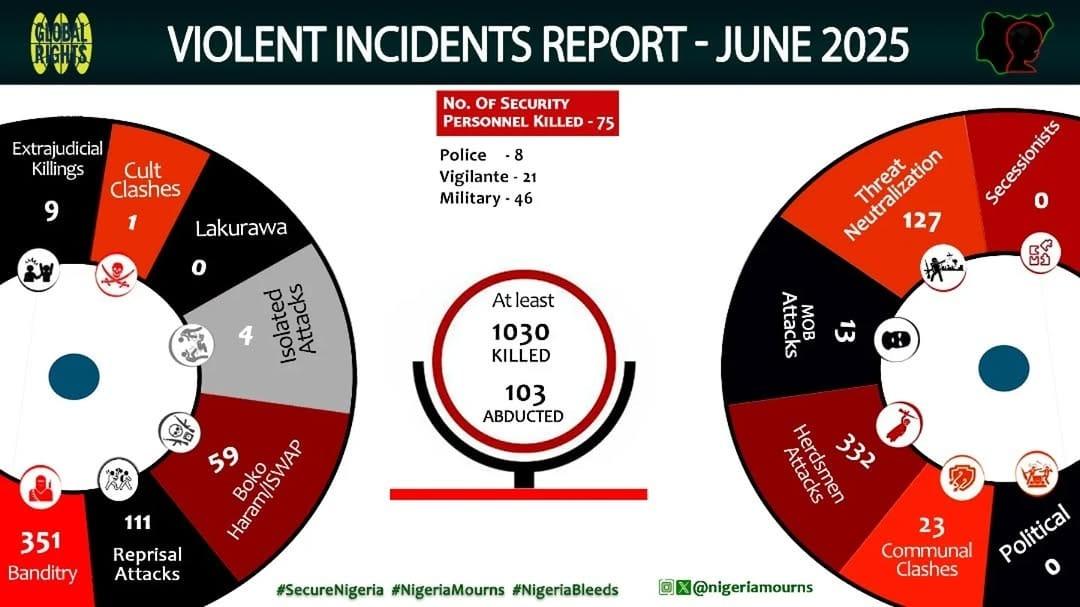
In June 2025, at least 1,030 people were killed across Nigeria, a 20 percent rise from May, marking one of the deadliest months this year. While reported abductions fell to 103, this drop likely reflects a dangerous collapse in reporting capacity due to fear, media blackouts, and destroyed community networks rather than any genuine improvement in security.
The month was defined by mass casualty events of shocking brutality in Benue, Zamfara, and Plateau States. The mass immolation of civilians in Benue’s Guma LGA highlighted the devastating freedom with which armed groups operate in areas of minimal state presence. Even limited security gains were irrelevant against a tide of violence that has entered a more aggressive, punitive phase, one that targets the very act of survival.
Attacks on Civilians
The human cost of June’s violence was severe, with Benue, Zamfara, and Plateau States accounting for the majority of recorded deaths.
In Benue State, at least 371 people were killed in a wave of coordinated massacres across Guma, Logo, and Ukum LGAs. In Yelewata and Daudu communities (Guma LGA), more than 200 people, including displaced families and security personnel, were burned alive during a midnight attack. Witnesses described a scene of deliberate annihilation_: “They poured petrol and burned the whole place where people were sleeping,”_ one survivor said. “Some families were wiped out completely.”
Elsewhere in Benue, at least 59 more deaths were recorded in simultaneous raids along the Yelewata–Nasarawa border, including casualties among military and civil defence officers.
In Zamfara State, at least 165 people were killed, many in Gusau LGA, where 30 farmers were massacred across multiple villages after refusing a ₦50 million “farming permit” demanded by a notorious bandit leader. The violence reflects how extortion has become embedded in rural economies, coercing farmers into choosing between payment or death.
Plateau State recorded at least 109 fatalities. In Riyom LGA, at least 58 residents were killed and 82 homes destroyed in attacks that unfolded over two days, while Mangu LGA experienced reprisal killings that claimed at least 20 lives within 24 hours. “They struck at dawn,” said the local chairman. “Most of the victims were attacked inside their homes.”
Kebbi State recorded at least 60 deaths. In Tadurga (Zuru LGA) and Kyebu (Danko Wasagu LGA), coordinated raids left at least 30 people dead, many others wounded, and a significant number of livestock stolen.
Borno State recorded at least 39 deaths, including at least 20 civilians killed when a female suicide bomber detonated an explosive device at a crowded fish market in Konduga on June 20. The blast left 18 others injured.
Smaller attacks were reported in Yobe (21), Niger (9), and Kaduna (4) States, bringing the month’s toll above a thousand.
These attacks have deepened the humanitarian crisis across rural Nigeria, where displaced families now face hunger, disease, and the collapse of livelihoods.
Security Operations
Security operations intensified across the northern regions, yet the cost in personnel and civilian lives remained high. At least 127 insurgents were neutralized, but 71 security officers including 46 soldiers, 8 police officers, and 21 civilian defenders were killed in action.
In Niger State, troops intercepted a large militant convoy near Kuchi (Munya LGA), killing at least 45 fighters linked to Dogo Gide’s network. In Zamfara’s Maru LGA, coordinated airstrikes destroyed camps in Maraya and Wabi villages, neutralizing at least 20 militants. However, the loss of five vigilantes underscored the risks faced by uncoordinated local actors.
A major escalation occurred when members of the Zamfara Civilian Protection Guards (CPG) launched an assault on Bello Turji’s stronghold in Shinkafi LGA. Over 100 of Turji’s fighters were killed, but the CPG suffered at least 20 casualties, including their commander, in what became one of the bloodiest local-led offensives in recent years.
In Borno State, troops repelled a large-scale ISWAP assault on Mallam Fatori IDP camp, killing at least 20 attackers. Along the Nigeria–Cameroon border, at least 10 more insurgents were neutralized, and anti-aircraft ammunition recovered from previous cross-border raids.
These operations demonstrated tactical resolve but limited strategic change. The continued high rate of casualties among security personnel revealed the urgent need for better coordination, protection, and logistical support for those on the frontlines.
Abductions
At least 103 abductions were documented in June marking a drop from May’s 306 cases, but far from indicative of safety. In many regions, kidnappings persisted but went unreported due to fear, limited access to media, and weakened community networks.
In Zamfara State, armed groups abducted eight residents from Fadama near Jangeru and Birnin Yero (Shinkafi LGA) on June 10. Days later, in Fangaltama (Talata Mafara LGA), assailants attacked at 3:00 a.m., kidnapping the chief imam and at least five others from homes opposite a military base.
In Benue State, at least 10 passengers were abducted from a Benue Links bus along the Owukpa–Orokam road (Ogbadibo LGA). In Niger State, nine people were kidnapped during back-to-back raids in Waya and Basawa (Kontagora LGA). Though vigilantes successfully rescued all victims, one defender was killed, and another wounded.
Smaller-scale incidents were reported in Kwara, Katsina, Nasarawa, FCT, Kaduna, Plateau, and Bayelsa States, showing that abductions even when reduced in number remain widespread, unpredictable, and deeply destabilizing.
Looking Ahead
June’s campaign of mass murder and terror confirms that Nigeria’s security crisis is evolving in scale and brutality, not receding. The coordinated assaults and acts of mass immolation reveal armed groups that are more capable and crueller, easily overwhelming a reactive and outmatched state response.
Breaking this cycle demands a strategy that matches the severity of the threat. This requires:
- Prioritizing Civilian Protection: Security deployments must be judged by their ability to prevent atrocities like the burning of entire communities, not just by insurgent body counts.
- Investing in Local Intelligence: Revitalizing and formally integrating local intelligence networks is essential to anticipate and intercept coordinated attacks before they begin.
- Launching a Financial Offensive: The extortion economy from “farming permits” to ransoms must be dismantled through targeted financial investigations and sanctions.
The roots of violence fester in poverty and exclusion. Ultimately, expanding access to food, justice, and livelihoods will do more to secure the nation than any single operation. The urgency is to shift from enduring losses to preventing them from counting the dead to protecting the living.