
Monthly summary
Summary of Mass Atrocities Casualties for July 2025
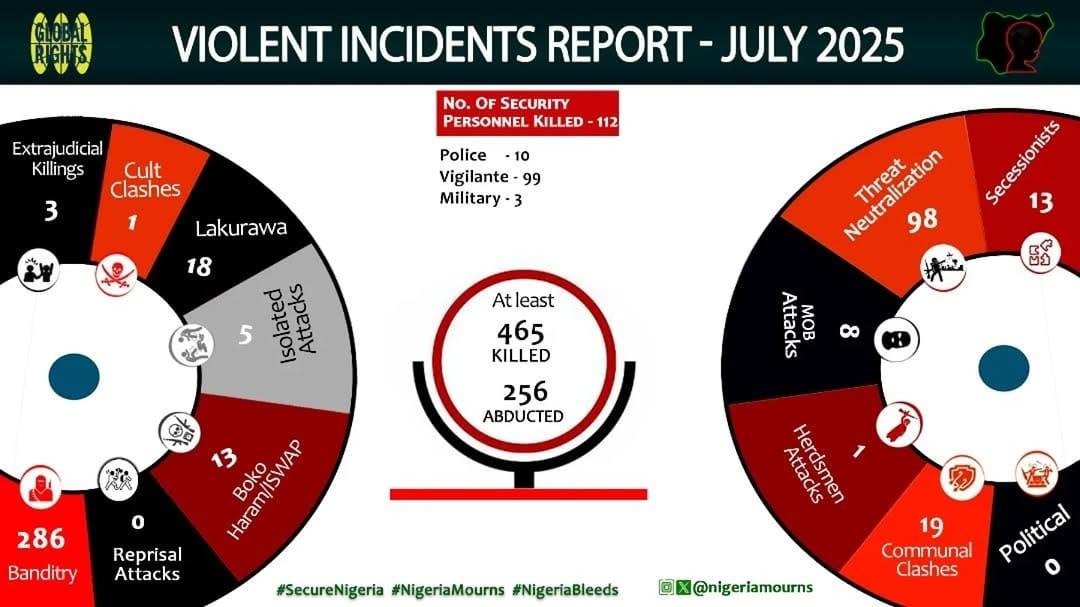
In July 2025, at least 466 people were killed and 256 abducted in incidents of armed violence across Nigeria. While documented killings fell significantly from the previous month, the 60 percent surge in abductions underscores a strategic shift by armed groups toward a more profitable and coercive model of violence amid persistent security failures.
The decline in fatalities offered a superficial reprieve, yet the persistence of mass kidnappings reveals a troubling normalization of hostage-taking as a primary tool for economic extraction and territorial control. These incidents are not isolated crimes but evidence of the sustained capacity of organized non-state actors to exploit fragile community defenses and operate with impunity. Behind these figures, families endure repeated displacement, shattered livelihoods, and the psychological toll of prolonged fear, highlighting the human cost of the state’s inability to ensure fundamental security.
Attacks on Civilians
Across the country, July’s violence revealed a familiar pattern of vulnerability with rural communities attacked during fieldwork, worshippers targeted in prayer, and families caught between ransom demands and reprisal killings. The heaviest tolls were recorded in Zamfara, Plateau, Anambra, Sokoto, Adamawa, and Benue States, though no region was left untouched.
In Zamfara State, tragedy struck Banga village in Kaura Namoda Local Government Area (LGA) when at least 38 abducted villagers were executed by terror-bandits despite the community paying over ₦50 million in ransom. Of the 56 residents taken a month earlier, only 18 had been released before the killings. In Kungurki village of the same LGA, three members of a joint vigilante-hunter unit were killed during a failed attempt to repel a large bandit movement. Across the state, at least 69 people were killed in July, reflecting the continued impunity of armed actors.
In Plateau State, attacks on rural communities persisted. On July 14, armed assailants killed at least 27 farmers, including women, in Bindi-Jebbu, Tahoss community, Riyom LGA. The following day, at least 15 more residents were killed in a separate attack on Jebbu. Security personnel under Operation Safe Haven responded after the attacks, recovering bodies and evacuating the injured, but the recurring pattern of delayed response continues to leave farming communities exposed during the planting season.
In Anambra State, unidentified gunmen attacked a community meeting in Ogboji, Orumba South LGA, killing at least 13 people between 6:00 and 7:00 p.m. Witnesses described how the attackers arrived in SUVs and opened fire indiscriminately before fleeing. The incident shocked local residents, renewing debates over the spread of violent non-state actors in the South-East.
Elsewhere, Sokoto (18), Adamawa (13), and Benue (10) States also recorded deadly incidents. Though total fatalities declined compared to June, the widespread nature and audacity of the attacks illustrated that the respite was statistical, not structural.
Security Operations
Security operations continued nationwide through July, yielding mixed results. While several high-value insurgents and bandit leaders were neutralised, the heavy losses among security personnel and local defenders revealed the strain of prolonged combat and the state’s inability to protect all areas.
In Niger State, troops supported by Department of State Services (DSS) intelligence neutralised at least 45 armed bandits advancing toward Iburu village, Shiroro LGA, on July 25. The joint operation successfully intercepted the group before it could strike nearby communities.
In Borno State, coordinated operations under Operation Hadin Kai, with air support and assistance from the Civilian Joint Task Force (CJTF) and local hunters, neutralised at least 24 insurgents across Konduga and Bama LGAs between July 4 and 9. Another 10 fighters were killed in Kalabalge LGA near the Nigeria–Cameroon border, disrupting a cross-border movement corridor.
In Sokoto State, Operation FANSAN YAMMA troops ambushed and killed three notorious terrorist commanders in Sabon Birni LGA on July 25. Local residents described the operation as a rare victory that briefly restored public confidence in security efforts.
However, July also brought significant losses. In Plateau State, at least 70 vigilantes were killed while defending Kukawa and Bunyun communities in Kanam LGA on July 6, following a large-scale assault by terror-bandits. In Zamfara, at least 14 members of the Community Protection Guards (CPG) were killed in two separate ambushes; eight in Jangege village (Talata Mafara LGA) while protecting farmers, and six more in Bungudu LGA during a condolence mission.
By the end of the month, at least three soldiers, ten police officers, and 99 vigilantes had been killed nationwide. These figures highlight both the courage of frontline responders and the urgent need to strengthen coordination, logistics, and protection for those confronting armed groups on behalf of the state.
Abductions
At least 256 abductions were recorded nationwide in July, marking a sharp 60 percent increase from June’s 103 cases. The rise reflects the expanding economic logic of kidnapping and the persistent gaps in preventive security, especially in rural and peri-urban zones.
In Zamfara State, at least 130 residents were abducted from Kairu community on July 5. Armed assailants stormed the settlement in daylight, killing six people and taking women, men, and children into nearby forests. Local officials described the attack as “overwhelming and unprovoked.”
In Katsina State, gunmen attacked farmlands near Yankara, Faskari LGA, killing two farmers and abducting at least 12 others. Similar incidents during the planting season have deepened fears of food insecurity and economic disruption across the region.
In Kogi State, two major incidents were documented. On July 10, bandits intercepted two buses in Ofugo, Ankpa LGA, abducting 10 traders returning from a local market. On July 26, nine passengers were kidnapped along the Lokoja–Abuja expressway after their vehicle was ambushed and diverted into the bush.
In Niger State, a midnight attack in Usubu, Kontagora LGA, on July 26 led to the abduction of at least six people, including a woman and her infant. Earlier, four farmers were abducted on July 6 in Munya LGA while working in their fields. One civilian was killed during a rescue attempt by local vigilantes.
In Bauchi State, at least 10 residents were abducted, and one killed in an early morning attack on Dogon Ruwa village, Alkaleri LGA, on July 5.
By the close of the month, abduction had become the dominant mode of violence, reshaping community life through fear, displacement, and financial exhaustion.
Looking Ahead
July’s patterns revealed the sobering truth that fatalities may have fallen, but abductions surged, signalling a shift in the economy of violence rather than progress toward stability. To counter this evolving threat, Nigeria must pivot from reactive military deployments to a strategy centered on human security. This requires:
- Strengthening Justice: Ensuring perpetrators face trial through robust judicial accountability, not negotiation.
- Investing in Prevention: Enhancing police forensic and intelligence capacities to shift from reaction to prevention.
- Addressing Root Causes: Reducing the economic desperation that fuels recruitment by investing in education, energy, and local livelihoods.
- Rebuilding Trust: Conducting transparent investigations into security lapses and providing visible support for victims.
Nigeria’s path to stability lies not only in stronger firepower but in stronger institutions anchored in justice, accountability, and inclusive development that restores safety and dignity to its people.