
Monthly summary
Summary of Mass Atrocities Casualties for January 2026
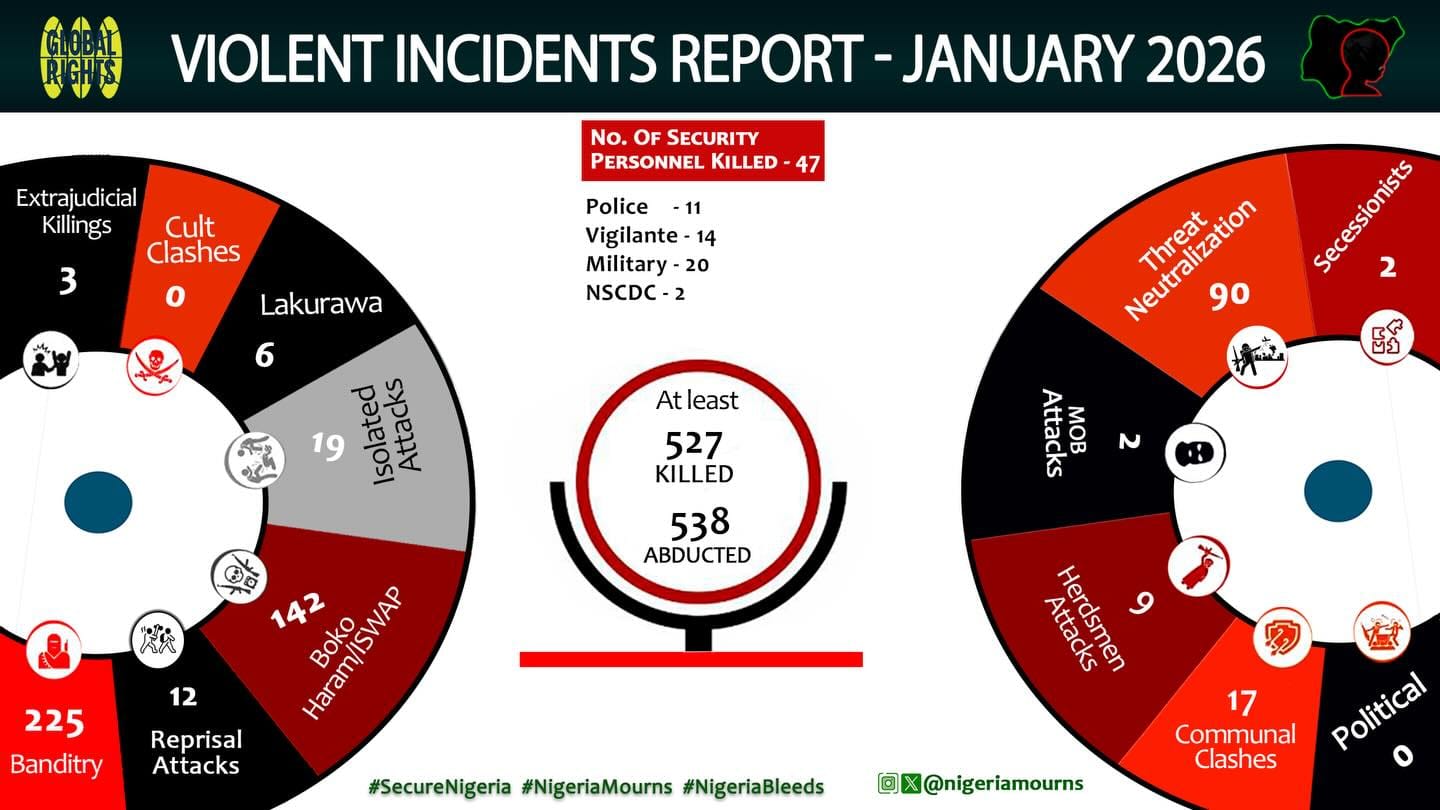
January 2026 recorded at least 293 fatalities and 534 abductions across Nigeria. Compared to December 2025, the month witnessed a sharp escalation in both killings and kidnappings, signaling a renewed expansion of armed group activity after the relative decline observed at the end of the previous year.
The surge in violence was driven by large-scale attacks on markets, rural communities, and religious gatherings. While armed groups continued to exploit remote and poorly protected areas, the scale of several incidents suggested increasing operational confidence and mobility. Kidnapping also returned as a dominant tactic, particularly targeting worshippers and rural populations, indicating that criminal and insurgent networks remain capable of conducting coordinated mass abductions despite ongoing military pressure.
Attacks on Civilians
Civilians bore the overwhelming burden of violence during January, with major incidents recorded in Niger, Adamawa, and Borno States.
The deadliest attack occurred in Niger State, where bandits attacked a market in Mashegu Local Government Area (LGA), killing at least 60 people. The incident highlighted the vulnerability of commercial hubs that serve as economic lifelines for rural communities.
In Adamawa State, a communal clash in Lamurde LGA resulted in the deaths of at least three women, illustrating the continued role of local disputes in driving insecurity.
In Borno State, renewed fighting between Boko Haram and ISWAP factions in Abadam LGA reportedly left dozens of fighters dead. Although insurgents were the primary casualties, the conflict further destabilized communities already affected by years of displacement and violence.
Security Operations
Security forces maintained offensive operations across the North-East and North-West.
In Borno State, troops recorded multiple successes within the Timbuktu Triangle and surrounding operational areas, neutralizing dozens of insurgents and compelling others to surrender.
Additional operations in Benue and other states disrupted armed group activities and prevented several attacks on civilian communities.
Despite these gains, security forces suffered significant losses. At least 20 soldiers, 15 police officers, two NSCDC personnel, and 14 vigilantes were killed during the month. These casualties underscored the continued ability of armed groups to mount effective attacks against security personnel and highlighted the demanding nature of ongoing operations.
Abductions
At least 534 abductions were recorded nationwide, making kidnapping one of the defining features of January’s insecurity landscape.
The most significant incident occurred in Kaduna State, where at least 177 church members were abducted during an attack on a religious gathering. The scale of the incident intensified concerns about the increasing targeting of faith-based institutions.
Additional kidnappings were reported in Zamfara State, where at least 29 residents were abducted during a night raid, and in Kaduna and Ondo States, where several community members were seized in separate attacks.
The concentration of kidnappings around places of worship and community gatherings demonstrated how armed groups continue to exploit predictable civilian routines to maximize fear and leverage.
Looking Ahead
January’s trends suggest that the tactical recalibration observed in late 2025 has given way to a broader resurgence of violence. The return of large-scale killings alongside mass abductions indicates that armed groups are no longer relying solely on kidnapping-for-ransom but are employing a wider range of coercive tactics.
Persistent economic hardship, weak rural governance, and ongoing displacement continue to create conditions that favor armed recruitment and criminal activity. At the same time, attacks on markets, churches, and farming communities threaten local economies and social cohesion.
The coming months will test whether recent military offensives can translate into sustainable civilian protection. Without improvements in intelligence, rural security, and community resilience, January’s escalation may signal the beginning of a more volatile phase of the conflict.