
Monthly summary
Summary of Mass Atrocities Casualties for January 2025
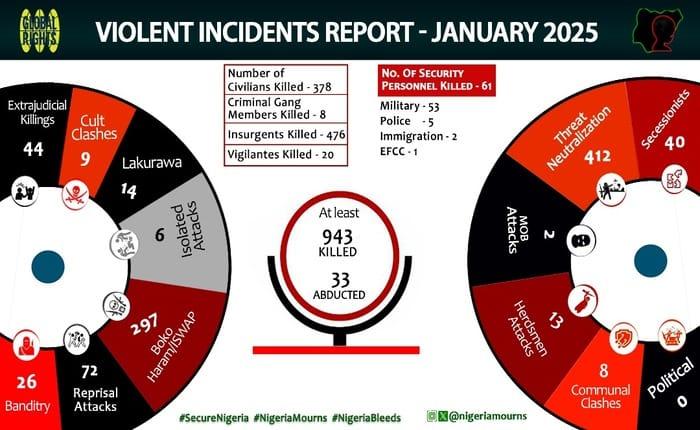
There were at least 968 fatalities in January 2025 – the highest monthly toll recorded in the past four years. This grim milestone, surpassing even the worst months of 2024, underscores a deepening security crisis despite intensified military operations. The surge follows a troubling pattern where mass atrocities consistently escalate in the first quarter, with January setting the tone for the year.
The following breakdown of casualties across states provides a clearer picture of the violence and its devastating impact.
Casualty Overview
Borno State recorded the highest death toll in January, with at least 241 fatalities (24.5% of the total). In Dumba Local Government Area (LGA), Boko Haram launched a brutal attack in the early hours of Sunday, the 12th, killing at least 147 farmers and fishermen. Later in the month, the same LGA suffered another attack, resulting in at least 40 additional casualties. In Gadan Gari LGA, Boko Haram killed at least 20 fishermen. “We have buried more than 15 victims, and my child was among those killed” lamented Mustapha Kacahallah, a local resident.
In Zamfara State, a military airstrike in Tungar Kara LGA claimed at least 20 civilians lives as collateral damage. The strike, intended to neutralize a terrorist group, struck local security forces and residents who had mobilized to repel cattle rustlers.
At least 40 people were macheted to death by members of the Indigenous People of Biafra (IPOB) across several communities in Orsu LGA, Imo State. Investigations revealed that the attacks were part of a systematic ploy to instill fear and force communities to abandon their lands.
Communal attacks and cult clashes in Ondo State resulted in at least 11 fatalities. Notably was a cult clash in Owo LGA that claimed four lives, including a mother and her baby, and the killing of five people in a communal clash in Gbalegi community (Idanre LGA) over a boundary dispute.
Atrocious violence in other states also claimed lives in: Jigawa (11 fatalities), Nasarawa (10), Kebbi (9), Yobe (7), Katsina (4), Bayelsa (3), Ogun (3), Oyo (3), Sokoto (3), and Ebonyi (3).
Extremist clashes
Escalating rival clashes between Islamic State West Africa Province (ISWAP) and Jama’atu Ahlis-Sunna Lidda’Awati Wal-Jihad (JAS) led to the deaths of at least 50 JAS fighters in Mobbar LGA of Borno State. Additionally, the factional rivalry between Dogo Gide and Sadiku Boko Haram resulted in the deaths of at least 20 Sadiku Boko Haram fighters.
Security Operations
The armed forces continued in their quest to curb the insurgency and abductions. In Borno State, the army informed that they had neutralized at least 76 Islamist militants in Dumba LGA, rescuing hostages and recovering weapons. In Sabon Gari community (Damboa LGA), they foiled an ambush on their base, killing at least 34 terrorists.
In Zamfara State, they claimed that they had neutralized at least 31 insurgents in Gidan Rijiya (Shinkafi LGA) and at least 25 insurgents in Fakai community, rescuing seven kidnapped victims.
In Katsina State, a joint operation neutralized at least 80 terror-bandits, disrupting their operations in Jibia, Batsari, and Batagarawa LGAs. In Kebbi State, security forces conducted raids in Augie, Arewa, Argungu, and Dandi LGAs, neutralizing at least 20 insurgents and clearing Manja village, which had been deserted for four years after it was run over by terrorists.
Despite these successes, the armed forces lost at least 53 officers in ambushes and attacks on security installations. This number includes 5 police officers, 20 vigilantes, 2 immigration officers, and one EFCC agent.
Abductions
There was a significant decrease in abductions in January, with 33 cases reported. In Kaduna State, terror-bandits abducted at least 22 people, mostly women and children, from Kitanda and Kumana communities (Kauru LGA). Residents lamented the inadequate security presence, as only three officers were assigned to protect the entire area.
In the Federal Capital Territory, terror-bandits kidnapped five residents of Chikakore, Bwari LGA. The attackers, numbering more than 30, stormed the community and abducted victims from their homes. As of the time of this report, no ransom demands have been made.
In Katsina State, terror-bandits abducted three persons from Kankara General Hospital, injuring a doctor and a healthcare worker. Other states in which abductions were reported include Kogi (1), Anambra (1), Lagos (1), and Ogun (1). While security forces rescued some victims from previous abductions, these rescues did not occur in these states.
Looking Ahead
Behind these staggering numbers loom fundamental questions that demand answers: Why do insurgent neutralizations consistently fail to protect civilians? Are terror groups regenerating faster than security forces can eliminate them? Could misleading success reports be obscuring institutional failures? The mass displacement of communities, deserted farmlands, rampant misinformation, and entrenched inequalities collectively portray a nation teetering between crisis and potential transformation.
January 2025’s unprecedented violence serves as a dire warning: Nigeria’s security paradigm requires immediate, fundamental restructuring. While tactical military operations have yielded localized successes, their reactive nature cannot overcome insurgents’ evolving strategies and deepening societal fractures. The bloodshed exposes systemic vulnerabilities that demand more than battlefield solutions – it calls for comprehensive human security addressing justice disparities, economic inequalities, and governance gaps.
This crisis compels decisive action on three fronts:
- Immediate civilian protection through reinforced community safeguards and intelligence-driven operations.
- Trust restoration via transparent investigations into security failures and civilian harm.
- Sustainable peacebuilding by tackling the socioeconomic roots of violence.
The path forward requires:
- Enhanced early warning systems integrating traditional and technological solutions.
- Reformed intelligence-sharing protocols between security agencies and communities.
- Targeted development initiatives in high-risk regions to address deprivation-driven radicalization
These measures must form the foundation of Nigeria’s new security architecture – one that prioritizes human security as vigorously as military objectives. Only through this dual approach can the cycle of violence be broken and lasting stability achieved.