
Monthly summary
Summary of Mass Atrocities Casualties for February 2025
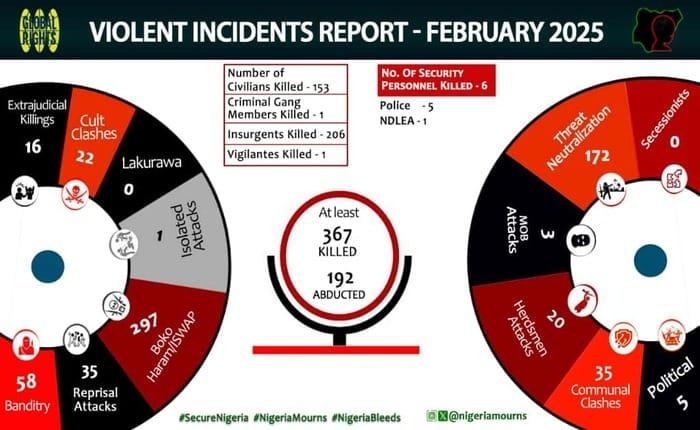
In February 2025 there was a significant de-escalation in the violence that marked the beginning of the year, with at least 367 fatalities recorded—a 61% drop compared to January’s count of 943. For most communities in the North-West of the country, the month was anything but peaceful. January’s unprecedented surge in mass atrocities raised critical questions about the effectiveness of current security strategies, the adaptability of insurgent groups, and the systemic challenges undermining peace and stability.
The following breakdown of casualties across states provides a clearer picture of the violence and its devastating impact, offering insights into the evolving nature of the crisis and the urgent need for sustained, holistic solutions.
Casualty Overview
Katsina State recorded the highest casualty figure this month, with at least 29 fatalities, including 10 produce traders ambushed by terror-bandits at Takoki village in Funtua Local Government Area (LGA) on their return journey from purchasing tomatoes in Katsina and Zamfara states. Reports indicate that in a desperate attempt to evade their attackers, the driver of the truck carrying the traders reversed at high speed, causing the vehicle to plunge off a bridge. This tragic incident led to the loss of the traders, while seven others sustained injuries. Additionally, the whereabouts of five traders remain unknown, and goods worth N60 million were reportedly destroyed. In a separate incident, terror-bandits launched coordinated attacks on Gidan Sule and Kwana Doka villages in Faskari LGA, leaving at least three people dead and several injured. Several homes were also arsoned in the attack which occurred around 10:00 p.m. on February 23. Three people were shot dead, and several houses were set ablaze. Residents of Kwana Doka also confirmed that two people sustained serious gunshot injuries and were rushed to General Hospital, Funtua, for treatment.
At least seven non combatant civilians were collateral damage in yet another military airstrike in Yauni community, Zakka ward of Safana LGA, killed. Katsina’s high casualty figures highlight the persistent threat posed by terror-bandits, who continue to target civilians, disrupt livelihoods, and instill fear in vulnerable communities.
Several communities in Edo State came under terror-bandit attacks leaving at least 22 dead. On Friday, February 21, the communities of Marindoti, Gbelemontin Domiju, Kola Village, Taiye Camp, Eto Camp, Dipe, Bala Dele, and Thousand in Ovia South-West LGA were awakened in the early hours by attackers who unleashed terror shooting indiscriminately, setting houses ablaze, and destroying property, including motorcycles and vehicles. “We woke up to the sound of gunfire and screams,” said a resident survivor. “By morning, our homes were gone, and many of our neighbours were dead.” Sources indicate the attack was linked to a communal clash, triggered by the killing of at least five individuals of Ijaw extraction by hired local vigilantes guarding cocoa farms. Suspected sympathizers of the victims staged a counterattack, resulting in the death of members of the communities. The violence in the state underscores the dangers of communal clashes and the devastating consequences of unresolved disputes, which often escalate into large-scale attacks on civilians.
Rivers State was the stomping ground of rival cult groups engaged in a supremacy battle, leaving at least 19 people dead in Obelle Community, Emohua LGA. The violence triggered widespread panic, forcing residents to flee the community in search of safety. “We had to leave everything behind,” said Kingsley, a displaced resident. “The fighting was too close to our homes, and we feared for our lives.” Investigations reveal that the conflict between the Naked Wire and Carol cult groups was fueled by a dispute over levies from oil companies operating in the area. This incident underscores the growing influence of criminal groups in local disputes and highlights the urgent need for interventions to address the root causes of such conflicts.
Zamfara State experienced sustained waves of deadly attacks by terror-bandits, leading to the deaths of at least 20 people. The most notable attacks occurred in Gusau, Bukkuyum, Zurmi, Kaura-Namoda, Maru, and Anka LGAs, killing at least five people and abducting more than 50, mostly women and children. Among those abducted was the Vice Chairman of Bukkuyum LGA, Hon. Bala Muhammad Majidadi. In Maru LGA, terror-bandits mounted an ambush on the Gusau-Dansadau highway, killing at least eight people, including children, and abducting at least 20 others. Terror-bandits have continued to exploit the region’s security gaps to launch audacious mass abductions and the assassinations of high-profile citizens.
At least 15 people were killed and several houses burned in Amagu, Amaokwe, and Umunesha in Nkalaha LGA of Ebonyi State when suspected herders invaded their communities. Many members of the communities remain missing and unaccounted for. These attacks reflect the escalating tensions between herders and farmers, which have resulted in significant loss of life and displacement in the region.
Niger State recorded at least nine fatalities after terror-bandits attacked Karaga village, Bassa Ward, in Shiroro LGA. After attacking Karaga, the bandits moved on to Farin-Doki, where they kidnapped six people and rustled a significant number of cattle belonging to the locals. In Rafi LGA, an improvised explosive device (IED) planted near a military camp by suspected terror-bandits killed one person. The device, believed to have been intended to target security operatives, was accidentally triggered by residents on a motorcycle. These incidents highlight the vulnerability of rural communities to terror-bandit attacks, which devastate livelihoods and displace families.
Other states also reported violence: Osun (9 fatalities), Kano (4), Lagos (4), FCT (2), Jigawa (2), Gombe (1), Kaduna (1), and Delta (1).
Security Operations
February 2025 showed significant efforts by Nigerian security forces to combat insurgency and banditry across the country, with at least 206 insurgents neutralized in various operations. These operations targeted key hotspots and disrupted terror group activities, despite challenges such as intense fighting and IED threats.
In Zamfara State, Nigerian troops neutralized at least 50 insurgents in a fierce battle and inflicted serious injuries on 25 others, including high-profile terror commanders. The operation secured control of the Tungan Fulani Hills, a strategic location serving as a key route for arms smuggling from Niger Republic and Mali. In similar operations across Kashabawa, Bwarare, Zaki, Badarawa, and Sakarawa Hills, troops neutralized at least 44 insurgents despite intense resistance and IED threats.
In Borno State, escalating rivalry between terror factions led to the deaths of at least 31 Islamic State West Africa Province (ISWAP) fighters during clashes with a faction of Boko Haram. The assault, which began in the early hours of February 14, targeted ISWAP camps in Abadam LGA and resulted in the killing of several top commanders of the faction. In a separate operation, Nigerian troops neutralized at least nine violent extremists during a raid on an ISWAP and Jama’atu Ahlis Sunna Lidda’awati Wal-Jihad (JAS) enclave in Bama LGA. The troops engaged the terrorists in a firefight that lasted several hours, recovering weapons after the operation. A similar raid in Gura Ba within the same LGA led to the neutralization of at least seven terrorists and the recovery of ammunition.
In Katsina State, a joint military operation neutralized at least nine terror-bandits, including a notorious kingpin, Kamilu Chiroma, also known as Buzaro, following actionable intelligence and reconnaissance. In a separate incident, the Nigeria Security and Civil Defence Corps (NSCDC) repelled an attack on the permanent site of the Federal University Dutsinma in Dutsinma LGA, neutralizing four terror-bandits, rescuing three kidnapped victims, and recovering rustled goats. Other successful operations included repelling attacks on the Federal Government Special Grains Reserve in Darawa, Gago village, and Isah Kaita College of Education in Dutsinma. In a notable incident, residents of Tafoki village in Faskari LGA killed at least three terror-bandits in a botched attack. The bandits, who had been injured and captured by villagers, were subsequently extrajudiciously killed.
In Kebbi State, a joint operation by the police and local vigilantes resulted in the neutralization of at least four suspected kidnappers and the rescue of a 60-year-old victim, Umaru Bawa, who had been abducted from his home by the armed men who had stormed Gobiraje Village in Suru LGA on February 14, 2025. A swift response by the combined team led to the pursuit of the kidnappers into Tundufai Forest in Dakingari and the successful rescue of the victim unharmed.
Despite these successes, the month was not without losses among the ranks of security agents. While there were no recorded fatalities among the armed forces, at least five police officers, one vigilante, and one NDLEA officer lost their lives in the line of duty.
The security operations in February 2025 demonstrate the continued efforts of Nigerian security forces to combat insurgency and banditry. While significant gains were made, the losses sustained by police and vigilantes highlight the ongoing risks faced by those on the frontlines of this struggle.
Abductions
Abduction cases surged dramatically in February 2025, with at least 192 incidents recorded—an 83.3% increase from January’s count of 33 cases. The North-West remained the epicenter of abductions, with terror-bandits continuing to target vulnerable communities and travelers.
In Zamfara State, terror-bandits mounted a roadblock on the Gusau-Dansadau highway around ‘Mashayar Zaki’ in Maru LGA, abducting at least 20 people. The attack left four dead and scores injured. Across Gusau, Bukkuyum, Zurmi, Kaura-Namoda, Maru, and Anka LGAs, at least 50 people, mostly women and children, were abducted. Among the victims was the Vice Chairman of Bukkuyum LGA, Hon. Bala Muhammad Majidadi.
In Niger State, terror-bandits attacked several villages in Shiroro and Munya LGAs, killing one person, kidnapping several others, and rustling an unconfirmed number of cattle. In Sarkin Pawa, the Council Secretary was abducted along with at least four others in a late-night attack. In the Palaita community, Shiroro LGA—a town hosting hundreds of displaced persons—terror-bandits abducted at least nine individuals, including five men and four women. A resident of Erena, Hannatu Kabiru, who provided shelter for displaced persons from Palaita, reported that the terrorists raided Kutako, Dakpala, and Gogala villages before targeting Palaita. In Dakpala Village, Shiroro LGA, terror-bandits abducted at least eight people, including a mother, Abiba Salogo, and her baby, and rustled 115 cattle.
In Rivers State, pirates hijacked a passenger boat carrying 20 travelers along the Bonny-Okrika waterways in Bonny LGA. Initial reports indicated that 13 travelers were missing, while seven escaped. Security operatives later rescued nine of the missing passengers, with efforts ongoing to free the remaining victims.
In Katsina State, a former Director-General of the National Youth Service Corps (NYSC) was abducted along with at least 12 others in Tsiga village, Bakori LGA, during a midnight raid on February 6. Efforts to rescue them have so far been unsuccessful.
While abductions continue to be gross underreported, other reported cases of abductions across the states include: Benue (4), Federal Capital Territory (1), Adamawa (6), Borno (1), Gombe (1), and Kano (1).
The sharp rise in abductions in February 2025 highlights the audacity of terror-bandits and the vulnerability of communities across Nigeria. The targeting of high-profile individuals, women, and children underscores the urgent need for enhanced security measures and coordinated efforts to protect civilians and dismantle criminal networks.
Looking Ahead
While the reduction in fatalities may reflect the impact of intensified security operations, it also raises critical questions about the sustainability of these gains. The sharp rise in abductions, particularly in the North-West, underscores the adaptability of terror-bandits and their continued ability to exploit vulnerabilities in Nigeria’s security architecture.
The persistent violence across states like Katsina, Zamfara, and Niger highlights the deep-rooted challenges facing rural communities, including the displacement of families, the destruction of livelihoods, and the erosion of trust in security forces. The targeting of high-profile individuals, women, and children in abduction cases further emphasizes the audacity of criminal networks and the urgent need for enhanced protection measures.
In February, security forces neutralized over 200 insurgents and took out key leaders. However, we must ask: do these short-term wins actually make Nigeria safer in the long run? Studies show that military action alone can backfire—it may push more people to join extremist groups while ignoring the real problems that lead to violence (like poverty, poor governance, and extremist propaganda).
The heavy losses suffered by police and soldiers—especially from bomb attacks and targeted raids—prove that just reacting to attacks isn’t enough. Nigeria needs to focus more on stopping violence before it starts by:
- Fixing the root causes of extremism (jobs, fair governance, and countering harmful ideologies).
- Letting communities lead efforts to rehabilitate former extremists’
- Using early warning systems to prevent conflicts, not just responding to them.
These have worked in places like Indonesia and Somalia, where combining jobs programs with community outreach reduced violence more than military action alone.