
Monthly summary
Summary of Mass Atrocities Casualties for December 2025
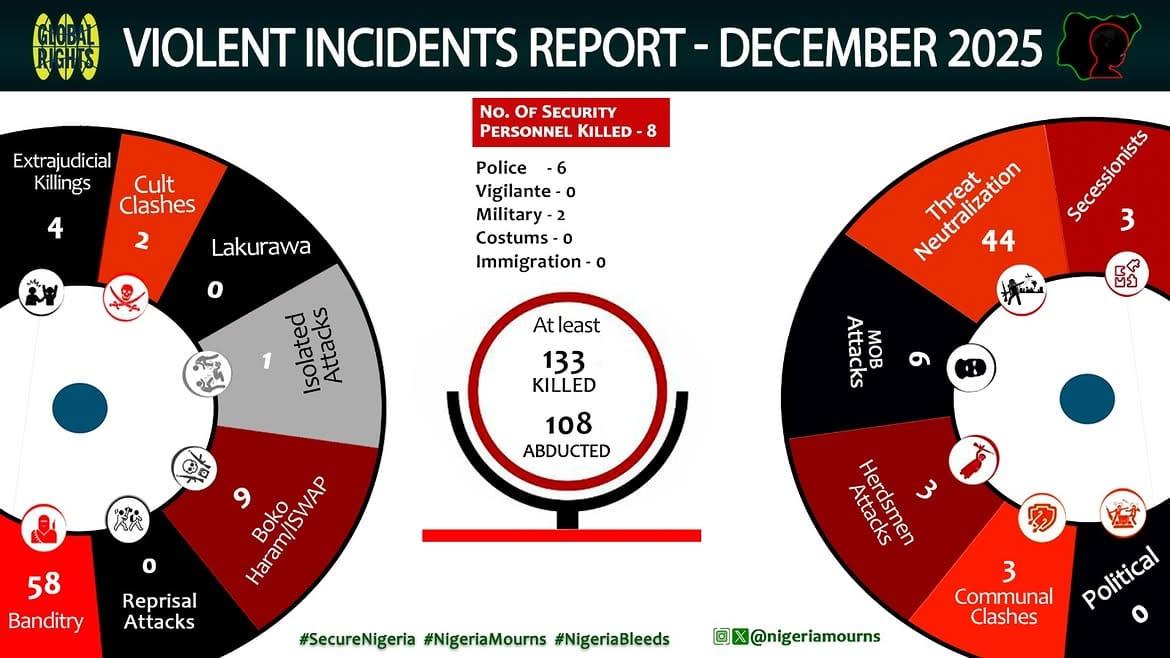
December 2025 recorded at least 133 fatalities and 108 abductions across Nigeria. These figures represent a decline from November’s extreme levels of violence, particularly in mass kidnappings. However, the reduction does not signal improved security. Instead, it reflects a tactical shift by armed groups away from large-scale hostage taking toward targeted attacks on vulnerable civilian spaces and transport corridors.
Where November was dominated by mass abductions of students and worshippers, December saw renewed focus on displacement settlements, mining communities, mosques, and highways. The pattern points to adaptation rather than retreat, with violence continuing to target soft locations where state protection remains weakest.
Attacks on Civilians
Civilians continued to bear the brunt of violence in December, with fatal incidents recorded in Taraba, Plateau, and Borno States. These attacks targeted populations already exposed to displacement, poverty, and weak security presence.
In Taraba State, gunmen attacked a community hosting internally displaced persons, killing at least 17 people and injuring several others. The assault struck families who had already fled earlier violence, reinforcing the absence of safe refuge for displaced populations.
In Plateau State, at least 12 miners were killed in an armed attack on a mining site in Bassa Local Government Area. The incident highlighted the growing exposure of informal economic hubs to violence, particularly in areas where competition over land and resources intersects with weak law enforcement.
In Borno State, a suicide bombing targeted a mosque in Maiduguri, killing at least five worshippers and injuring dozens. The attack revived fears of insurgent reach into urban civilian spaces and underscored the symbolic impact of assaults on places of worship.
Security Operations
Security forces sustained counter insurgency and counter banditry operations across the North East and North West during December, recording tactical successes while continuing to incur losses.
Security forces conducted counter insurgency and counter banditry operations across Borno and Sokoto States. In Damboa Local Government Area of Borno, troops supported by local vigilantes neutralised at least 21 insurgents and disrupted a logistics movement. In Sabon Birni Local Government Area of Sokoto, at least 11 militants were killed during an ambush operation.
December also saw confirmed United States airstrikes targeting Islamic State linked fighters in Tangaza area of Sokoto State, conducted in coordination with Nigerian authorities. While this reflected heightened international engagement, it also underscored the persistence of insurgent strongholds despite years of military campaigns.
At least two soldiers and six police officers were killed during the month, highlighting continued operational risks and the gap between battlefield gains and sustained civilian protection.
Abductions
At least 108 abductions were recorded in December, marking a sharp decline from November’s mass kidnappings. However, kidnapping remained a central tactic.
In Zamfara State, bandit attacks on rural communities led to multiple abductions and at least one fatality. In Tsafe Local Government Area, at least 20 people were abducted during a separate raid.
Along the Okene–Auchi highway in Kogi State, gunmen attacked vehicles in transit, killing a soldier and abducting at least 13 passengers. The incident illustrated the continued vulnerability of major transport corridors and the use of road abductions as a source of ransom and control.
Together, these cases showed a shift from school abductions to highway and village level kidnappings, maintaining pressure on mobility, trade, and rural life.
Looking Ahead
December’s trends suggest that Nigeria’s insecurity is recalibrating after November’s surge in mass kidnappings rather than declining. Armed groups appear to be adjusting tactics in response to heightened attention and pressure by shifting toward targeted attacks on civilians, transport routes, and economically sensitive locations.
Leadership transitions within the security sector, intensified international involvement, and weak rural governance continue to shape the operational environment. While airstrikes and offensives may disrupt specific cells, they risk dispersing armed actors into civilian areas unless paired with stronger intelligence continuity and local protection.
Socio-economic stress remains central. Displacement, unemployment, and food insecurity sustain recruitment and reduce community resilience. Each attack on miners undermines livelihoods, each assault on worshippers deepens communal fear, and each highway abduction restricts movement and trade.
December’s decline in raw numbers should not be misread as strategic improvement. It reflects an evolving pattern of violence that is becoming more adaptive, more embedded in everyday life, and more corrosive to civilian safety and state authority.