
Monthly summary
Summary of Mass Atrocities Casualties for August 2025
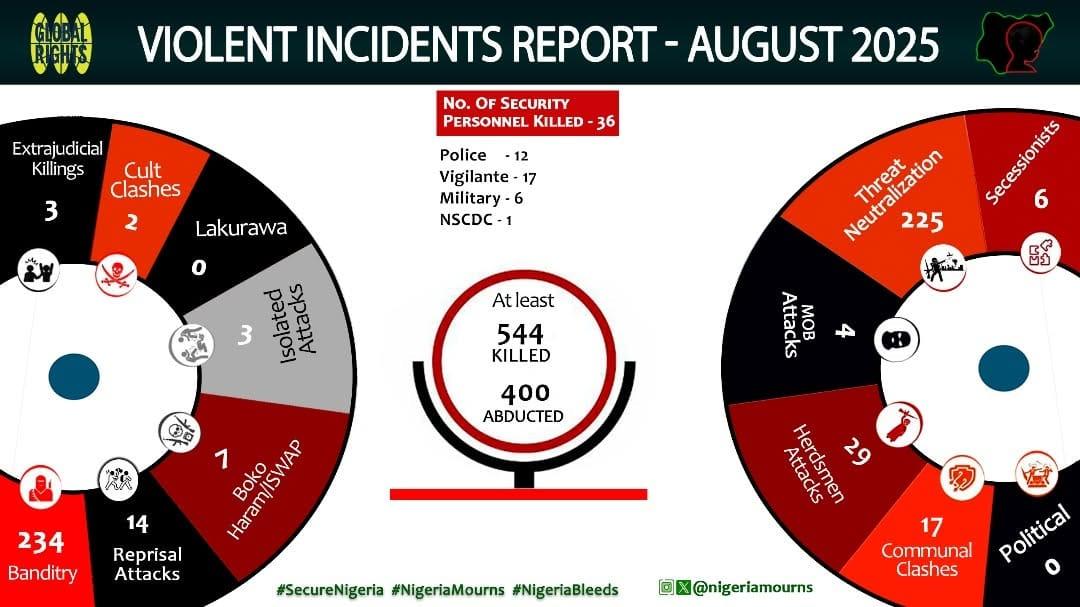
In August 2025, at least 544 people were killed and 400 abducted in incidents of armed violence across Nigeria. This represents a 14.5 percent increase in killings and a 56.5 percent rise in abductions compared to July, confirming not merely a statistical escalation but a chilling geographic and tactical expansion of the conflict.
The violence that persisted during the month demonstrated a deliberate broadening of targets, with attacks systematically directed at mosques, farmlands, police stations, and rural markets. These incidents are not random outbreaks but evidence of a strategic intent to demonstrate dominance and erode any remaining sense of public safety. Despite intensified security operations, the persistence of these assaults underscores the fatal limits of purely kinetic responses and the urgent, unmet need for a coherent, preventive strategy to protect civilians.
Attacks on Civilians
The month’s deadliest incident occurred in Katsina State, where terror-bandits stormed Unguwan Mantau in Malumfashi Local Government Area (LGA) during dawn prayers on August 19. At least 50 worshippers were killed, and 60 others abducted, as gunmen opened fire inside the mosque before torching homes. Witnesses said the attackers had earlier clashed with security forces elsewhere and turned on the village during their retreat. A tragic illustration of how reactive operations can redirect violence onto unprotected civilians.
In Plateau State, coordinated raids in Chakfem district, Mangu LGA, left at least 15 people dead across seven villages; Manden, Join, Jiblang, Koppang, Mihdihin, and Jilem. Homes were burned, and livestock stolen, aggravating food insecurity in a region already reeling from displacement.
In Benue State, renewed hostilities in Agatu LGA left at least nine people dead, including a police officer. The attackers, believed to have crossed from Kogi State, targeted farming settlements before retreating. Elsewhere, intercommunal clashes between Igede and Tiv communities in Oju, Obi, and Gwer East LGAs led to the death of two persons and destroyed farmland.
Kaduna State also witnessed repeated attacks. On August 10, terror-bandits raided Nasrawan Fatika (Giwa LGA), killing at least three people and rustling livestock. Two weeks later, gunmen invaded Angwan Rimi (Kauru LGA), killing at least seven, including women and children.
In Kwara State, heavily armed assailants attacked Babanla community (Ifelodun LGA), killing at least five, including a police officer, and looting the local market. Similar incidents in Bauchi (5), Ebonyi (9), Borno (4), Yobe (5), Taraba (3), and Zamfara (10) further underscored that the geography of atrocity is now national, not regional.
Security Operations
Security forces sustained multiple offensives across the North-West and North-East, neutralizing hundreds of insurgents and bandits. Yet, the uneven reach of these operations meant that rural communities still bore the brunt of retaliation and reprisal.
In Zamfara State, joint air and ground offensives on August 10 in Makakkari Forest (Bukuyum LGA) targeted a large gathering of armed groups preparing to attack Nasarawan Burkullu. At least 100 militants were neutralized, and their stronghold dismantled. Findings suggest that over 400 fighters had assembled for the planned assault, confirming the continued scale of armed mobilization in the region.
In Niger State, security forces thwarted a major attack on a Department of State Services (DSS) facility in Kumbashi (Mariga LGA), killing at least 50 attackers and rescuing several captives. Survivors recounted intense gunfire that lasted hours, with many assailants fleeing with injuries.
In Borno State, Operation Hadin Kai (OPHK) troops carried out clearance missions across Bama, Konduga, Gwoza, Magumeri, and Biu LGAs, neutralizing at least 17 insurgents and safely detonating 14 improvised explosive devices (IEDs). Additional operations in Tamsu Ngamdu, Dalakaleri, Gaza, and Loskori Kura, conducted between August 29 and 30 with the Civilian Joint Task Force (CJTF), resulted in at least 12 more insurgents killed.
Despite these achievements, losses remained steep. By month’s end, at least 36 security personnel including six soldiers, 12 police officers, one civil defence officer, and 17 vigilantes had been killed in action. These casualties highlight the human cost of sustained deployment and the urgent need for better equipment, intelligence coordination, and post-operation recovery support.
Abductions
At least 400 abductions were documented nationwide in August. A sharp 56.5 percent increase from July’s 256 cases. The abductions reflected both economic motivation and strategic intimidation, with entire communities targeted for ransom or submission.
In Zamfara State, at least 150 people were kidnapped over a period of four days across Sabon Garin Damri, Dakko Butsa, Tungar Abdu Dogo, Tungar Sarkin Daji, Sadeda, and Tungar Labi. Victims were seized during stormy nights, when visibility was low and roads were impassable.
In Katsina, at least 60 worshippers were abducted during the mosque attack in Unguwan Mantau where at least 50 people lost their lives, compounding the month’s death toll.
In Kwara State, at least seven people, including three children, were abducted from Gaa Oloyin Manasara and Eleyinvia villages (Isanlu Isin LGA) on August 28. Two women were earlier kidnapped from Edogi on August 8.
In Edo State, at least 18 passengers were seized along the Sobe–Benin road (Owan West LGA) on August 21, while in Sokoto, fighters loyal to Bello Turji abducted at least 16 people and killed one during an assault on Garki community.
Additional abductions were recorded in Niger, Benue, Plateau, Bauchi, Gombe, Kano, Nasarawa, and the FCT, confirming the national scope of the crisis.
By the end of August, kidnapping had entrenched itself as a parallel economy, a profitable, low-risk enterprise that continues to feed cycles of violence and displacement.
Looking Ahead
The events of August offer a grim lesson: Nigeria’s insecurity cannot be solved through force alone. Each new offensive, no matter how successful, is followed by fresh reprisals against civilians, revealing a strategy that is tactically busy but strategically bankrupt.
Breaking this cycle demands a fundamental reorientation towards a human-centric security strategy. This requires:
- Closing the Impunity Gap: A functioning justice system, supported by forensic policing, is the cornerstone of deterrence. Where impunity thrives, violence follows.
- Investing in Human Security: Empowering communities through education, livelihoods, and energy access is the most sustainable way to dismantle the recruitment base of armed groups.
- Rebuilding Trust through Accountability: Transparent investigations into abuses, fair compensation for victims, and visible justice for perpetrators are non-negotiable steps to rebuild public faith.
The task ahead is not only to secure territory but to restore the dignity and confidence that comes from a state that fulfils its most basic promise: to protect its people.