
Monthly summary
Summary of Mass Atrocities Casualties for April 2026
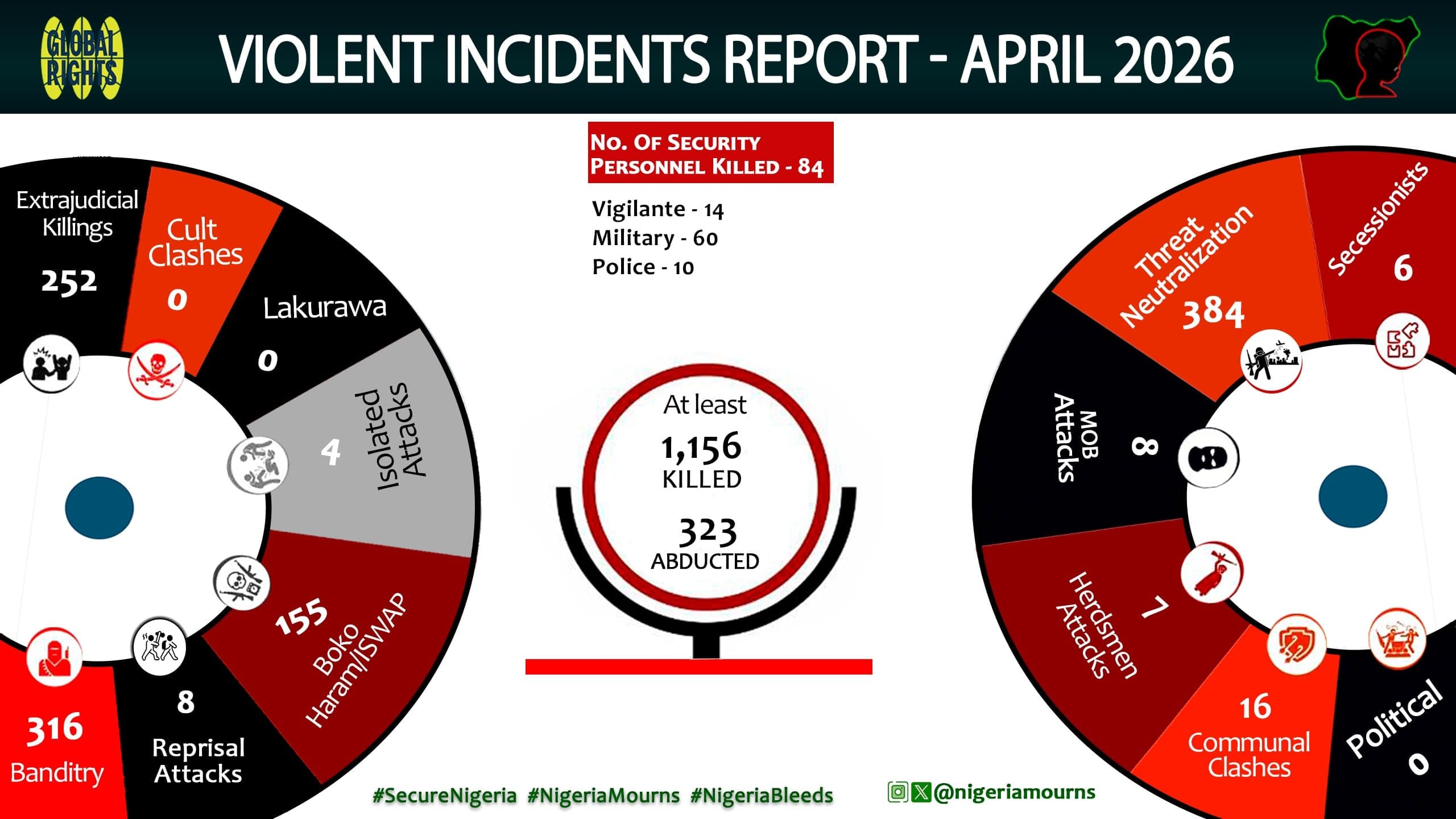
April 2026 recorded at least 648 fatalities and 321 abductions across Nigeria. Compared to March, fatalities rose sharply, while kidnappings declined by approximately 28 percent. Rather than indicating an improvement in security, the month’s figures suggest another tactical shift by armed groups, with mass casualty attacks once again emerging as the dominant form of violence.
The increase in killings was driven by coordinated attacks on rural communities, places of worship, and public gathering spaces, alongside significant civilian casualties linked to military operations. While fewer large-scale kidnappings were recorded, violence remained widespread and increasingly disruptive, exposing civilians to multiple and overlapping threats.
Attacks on Civilians
Civilians remained the primary victims of violence during April, with major incidents recorded in Kebbi, Yobe, Zamfara, Niger, and Borno States.
In Kebbi State, armed attackers killed at least 24 people during an assault on communities in Zuru Local Government Area (LGA), destroying both a church and a mosque. The attack highlighted the indiscriminate nature of violence affecting communities regardless of religious affiliation.
In Yobe State, an airstrike targeting armed groups reportedly resulted in the deaths of more than 200 civilians in Geidam LGA, highlighting the continued risks posed by military operations conducted in populated areas.
In Zamfara State, bandits attacked communities in Maru LGA, killing at least 20 residents, while Niger State recorded the recovery of at least 61 bodies following attacks on rural settlements. In Borno State, gunmen opened fire on spectators watching a football match in Gwoza LGA, killing at least 29 people and demonstrating the continued vulnerability of public gathering places.
Security Operations
Security forces sustained offensive operations across the North-East, North-West, and North-Central regions, targeting insurgent and bandit strongholds.
In Zamfara State, troops eliminated the son of a notorious bandit leader alongside dozens of fighters during coordinated operations. Air operations in Sambisa Forest destroyed insurgent enclaves, while troops in Borno State neutralised at least 24 terrorists and recovered weapons, preventing further attacks on nearby communities.
Joint operations involving the military, the Department of State Services, and local volunteer forces also disrupted bandit activities in Niger State, reflecting growing inter-agency cooperation.
Despite these successes, security forces continued to suffer heavy losses. At least 60 soldiers, 10 police officers, and a vigilante were killed during the month, highlighting the sustained operational cost of maintaining pressure across multiple conflict theatres.
Abductions
At least 1,156 abductions were documented nationwide, making April the most severe month for kidnapping in 2026.
The largest incident occurred in Kogi State, where gunmen abducted at least 23 pupils from a school in Yagba West LGA, reinforcing concerns over the renewed targeting of educational institutions.
In Benue State, armed groups abducted candidates travelling to sit for the Unified Tertiary Matriculation Examination (UTME), demonstrating how insecurity increasingly disrupts access to education beyond school premises.
In Katsina State, coordinated attacks across rural communities in Kankara LGA left one person dead and at least 15 others abducted. Together, these incidents illustrated how kidnapping continues to affect schools, transport routes, and rural settlements, deepening fear while disrupting education, mobility, and economic activity.
Looking Ahead
April’s trends indicate that kidnapping has become the dominant feature of Nigeria’s insecurity landscape. The unprecedented rise in abductions suggests that armed groups increasingly view hostage-taking as a sustainable strategy that delivers financial returns while stretching security resources across multiple locations simultaneously.
The continued targeting of schools, examination candidates, rural communities, and public spaces carries consequences that extend beyond immediate casualties. These attacks undermine confidence in education, restrict movement, weaken local economies, and deepen displacement in already fragile communities. At the same time, incidents involving civilian casualties during security operations highlight the importance of balancing military effectiveness with the protection of civilian lives.
As Nigeria moves further into 2026, sustaining battlefield successes will require more than offensive operations. Strengthening intelligence, protecting vulnerable civilian infrastructure, improving community-based security, and addressing the socio-economic conditions that sustain recruitment into armed groups will remain essential to reversing the country’s evolving insecurity trends.