
Monthly summary
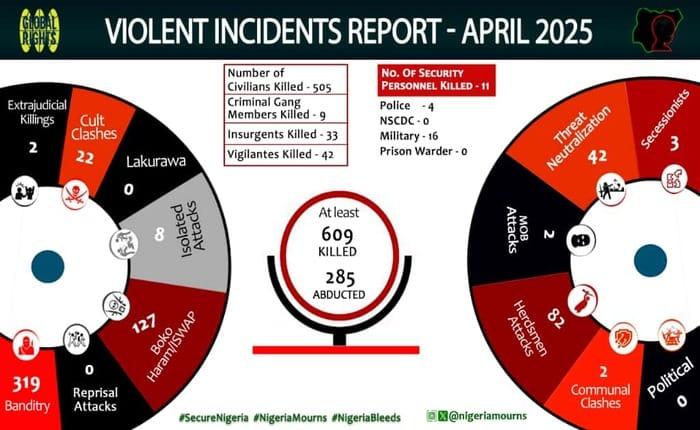
Summary of Mass Atrocities Casualties for April 2025
“While our troops fight with 20th-century tools, terrorists wield drones and satellite phones. This war cannot be won by bravery alone.”
-Senator Mohammed Ndume
At least 620 people were killed in Nigeria in April, a marginal rise from March, as armed groups continued to exploit a persistent gap between state intelligence and community protection. For thousands of displaced and traumatized civilians, tactical security gains offered little comfort in the face of mass killings and a shocking 68% surge in abductions.
The violence followed a brutal pattern: mourners were targeted at funerals, early warnings to security forces were ignored, and local vigilantes sustained devastating losses. The onset of the rainy season, which improves mobility for armed groups in forested terrain, raises concerns that April’s toll may be a grim harbinger of even greater violence in the coming months.
Attacks on Civilians
The deadliest incidents occurred in Plateau, Benue, Zamfara, and Borno States, though violence was documented nationwide.
In Plateau State, six communities in Bokkos Local Government Area (LGA) were attacked overnight on April 24, leaving at least 52 people dead and displacing over 2,000 residents. In Zike (Bassa LGA), at least 40 people were killed during a two-hour raid on April 14. Despite repeated warnings from residents, no security intervention arrived in time. In Ruwi village (Bokkos LGA), gunmen attacked a funeral on the same night, killing at least 11 mourners, including a pregnant woman and a child.
In Benue State, coordinated attacks by terror-bandits in Otukpo, Ukum, and Logo LGAs between April 16 and 18 left at least 72 people dead. Residents described prolonged assaults with little to no state protection, prompting further displacement.
In Borno State, insurgent activity intensified. On April 28, at least 26 civilians were killed when their vehicles struck improvised explosive devices (IEDs) on the Rann–Gamboru Ngala road. In Kwaple (Chibok LGA), Boko Haram fighters killed at least 15 people and abducted several others during a funeral.
In Zamfara State, at least 20 people were killed in an attack on Gobirawa Chali, a mining settlement on April 24. In Zibirin, the hometown of Nigeria’s Defence Minister, at least 16 residents were killed in a single raid.
Other notable incidents included:
- Katsina State: at least 18 killed in raids targeting farmers.
- Sokoto State: at least 14 killed in armed attacks.
- Edo State: at least 16 killed in cult-related reprisals in Benin City.
- Adamawa State: at least six killed in Boko Haram raids on Hong LGA communities.
Security Operations
Security forces documented neutralising at least 33 insurgents during April. However, at least 62 security personnel including 16 soldiers, 4 police officers, and 42 vigilantes were killed in action, revealing the deadly cost of the fight against adaptive and mobile armed groups.
In Zamfara State, vigilantes in Dansadau (Maru LGA) ambushed and killed at least 30 bandits on April 4, recovering 16 motorcycles. The success demonstrated the effectiveness of local intelligence but also the risks borne by under-equipped civilian defenders.
In Taraba State, troops of Operation Whirl Stroke dismantled bandit hideouts in Karim Lamido LGA on April 4, neutralising three fighters.
In Adamawa State, Boko Haram fighters killed 10 Civilian Joint Task Force members in Kopre (Hong LGA) on April 26. “They came on motorcycles with RPGs. Our boys were no match for them,” said a local chairman.
In Kebbi State, at least 13 vigilantes were killed in Morai (Augie LGA) on April 18.
In Enugu State, at least three police officers were killed in Oji River LGA on April 15.
In Delta State, police teams neutralised nine suspected kidnappers across Issele-Asagba and Otulu LGAs on April 21 and disrupted kidnapping networks along the Asaba–Ogwashi-Uku corridor.
In Borno State, a Boko Haram cross-border assault on Wulgo killed at least 12 Multi-National Joint Task Force soldiers, marking another example of the group’s growing technological sophistication, including drone and satellite phone use.
Abductions
At least 285 abduction cases were documented nationwide in April. A 68 percent increase from March’s 92 cases. The North West remained the epicentre.
In Zamfara State, simultaneous raids in Tsafe and Talata Mafara LGAs on April 14 led to three deaths and at least 80 abductions, including 40 women. Findings linked the attacks to reprisals following the killing of several bandit leaders.
In Katsina State, multiple abductions were reported between April 5 and 6:
- In Maikuma (Dandume LGA), at least four people were killed and 43 abducted.
- In Layin Gara (Funtua LGA), 100 armed men stormed the village at night, killing two and abducting at least 16 others. According to a survivor, “They operated like an army, not bandits… This is no longer just a crime, it is becoming an occupation.”
In Benue State, 14 passengers were abducted on April 24 along the Makurdi-Naka-Adoka highway in Gwer West LGA.
Isolated abductions were also reported in Kebbi and Ondo States, further reflecting the nationwide scope of kidnapping incidents.
Looking Ahead
April’s figures reveal that despite tactical progress, insecurity remains entrenched. The increase in abductions and the growing sophistication of insurgent operations point to an evolving conflict that cannot be resolved through force alone.
Nigeria’s security response must shift from reaction to prevention. This means closing the intelligence–action gap through real-time community-based alerts, ensuring that warnings lead to deployments rather than delayed investigations. It also requires professionalising local defence groups through structured training, clear oversight, and coordination with formal forces protecting both civilians and the volunteers themselves.
Equally important is dismantling the economic incentives of violence. Armed groups thrive on ransom payments, illicit mining, and extortion. Financial intelligence, targeted sanctions, and access to secure banking in rural areas can help disrupt this cycle.
Finally, restoring trust demands justice and human development. Strengthening the rule of law, improving policing standards, and expanding education and livelihoods in at-risk regions will reduce the social and economic vacuum that armed groups exploit.
Without these reforms, Nigeria risks remaining trapped in a cycle of reactive security and recurring tragedy. Preventive governance, accountability, and rights-based development remain the country’s clearest path to lasting safety and peace.